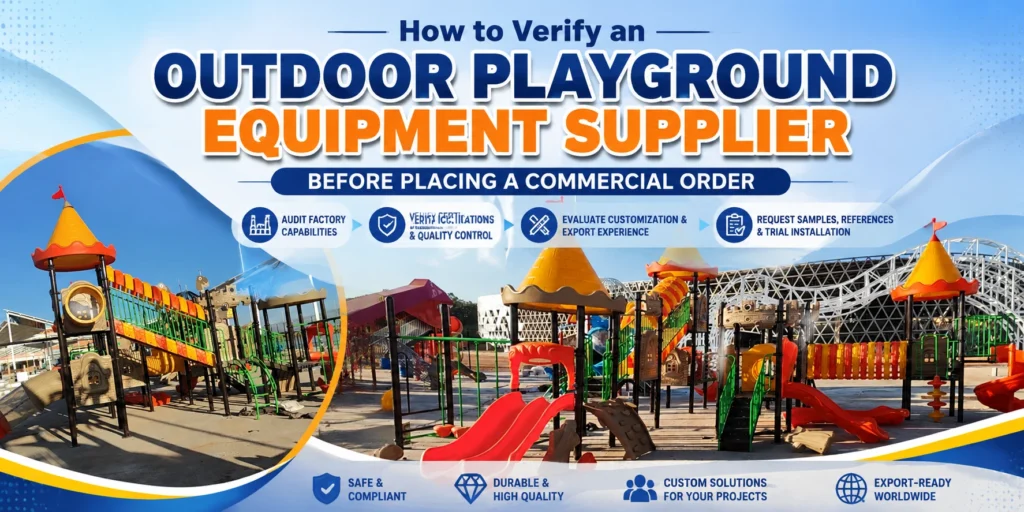
Finding a trustworthy outdoor playground equipment supplier is harder than it should be. The city of Wenzhou produces hundreds of playground manufacturers each year, yet the gap between a certified factory and a backyard assembler is often invisible from a website or Alibaba listing.
This category covers manufacturers and exporters that supply commercial-grade playground systems — modular slides, climbing frames, swings, and safety surfacing — to B2B clients such as schools, parks, developers, and tender contractors. The equipment must meet structural and safety standards for public use, not domestic backyard play sets.
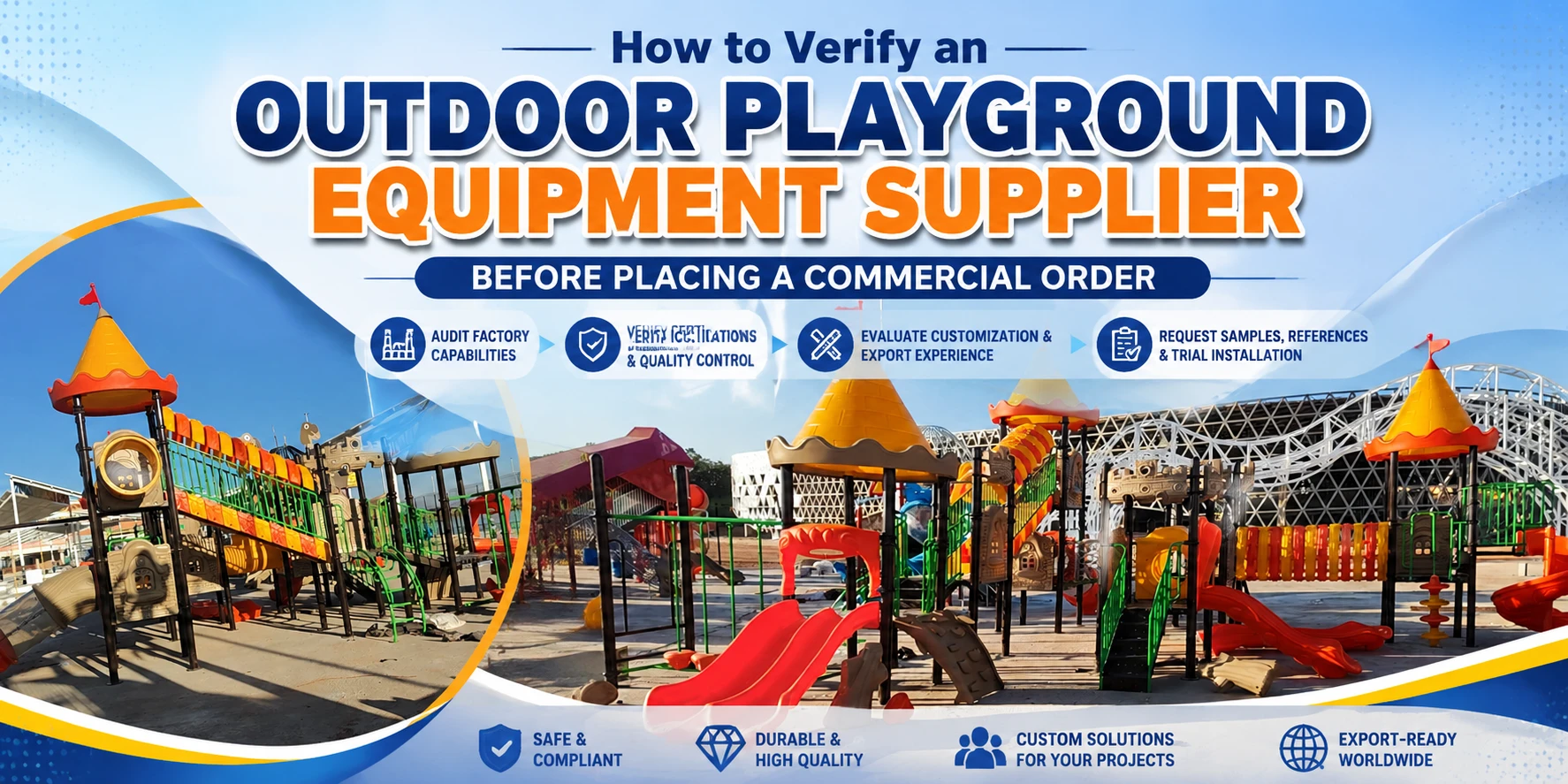
The problem is that not every supplier claiming to be a Wenzhou playground manufacturer actually has the production capacity, quality control, or export compliance to deliver on time and to spec. This guide walks you through four verification steps to reduce sourcing risk and confirm a supplier’s capability before you commit.
Why Supplier Verification Matters for Commercial Playground Equipment Buyers
Relying on an unverified supplier can cost you far more than the initial purchase price. Safety compliance failures, inconsistent product quality, and missed delivery deadlines are common when a supplier lacks proper oversight. Without verification, you risk receiving equipment that fails inspection, delays your project, or damages your reputation.
- ASTM/EN1176 certification gaps – a supplier may claim compliance but lack actual test reports. If your shipment arrives without valid certificates, local authorities can reject installation.
- Hidden MOQ changes – some manufacturers increase minimum order quantities after price agreement, forcing you to buy more units than needed.
- Poor material sourcing – cheaper grades of HDPE or thinner steel tubing reduce durability. Over time, panels crack, rust appears, and warranty claims mount.
One buyer lost a £45,000 school contract because the playground supplier’s slides did not meet EN 1176 fall-height requirements. The importer was left with unusable stock and no after-sales support. These failures are avoidable when you verify a supplier’s production capacity, quality control, and compliance history before placing a purchase order.
Step 1: Audit Factory Capabilities and Production Scale
Before committing to a purchase order, verify the physical capacity of your shortlisted playground factory in Wenzhou. Can they deliver your order volume on time without sacrificing quality?
Commercial playground equipment requires specific machinery: injection-moulding machines for HDPE panels (clamping force 800–2,000 tonnes), CNC routers for precision cutting, and robotic welding arms for steel frames. A factory that owns these machines rather than subcontracting them signals genuine in-house production. Ask for a video tour of the injection and welding lines.
Floor area and workforce size provide quick capacity indicators. A medium-sized factory handling export orders typically operates on at least 10,000 square metres with 150–300 workers. Annual output of 500–1,000 sets per year is common. Request a third-party inspection report from SGS or Bureau Veritas to confirm facilities.
Step 2: Verify Certifications and Quality Control Procedures
Once factory capacity is confirmed, verify that equipment meets safety standards for your target market. For Europe, EN 1176 governs playground equipment safety; in the USA, ASTM F1487 applies. CE marking indicates EU compliance, but must be backed by test reports from accredited bodies like TÜV or Intertek.
Certificates alone are not enough. Request the certificate number and issuing body’s accreditation scope, then verify validity with the testing organisation. Ask for the full test report, not just a summary. A responsible supplier carries out raw material testing, in-process inspection, and final random sampling (typically AQL 2.5 level II).
| Certification | Target Market | Key Requirements | Testing Body Examples |
|---|---|---|---|
| EN 1176 | Europe | Fall heights, entrapment, structural stability | TÜV SÜD, TÜV Rheinland, SGS |
| ASTM F1487 | USA | Access, barriers, impact attenuation | Intertek, Bureau Veritas |
| CE marking | European Economic Area | Typically requires EN 1176 testing | TÜV, notified bodies registered with NANDO |
Step 3: Evaluate Customization Capabilities and Export Experience
Bespoke design requests separate a true manufacturer from a re-seller. Check if the supplier runs its own injection moulding and CNC cutting lines. A factory with integrated production can turn around a new colour in under 15 days.
Request a project portfolio with at least three references from your target region. For Middle East buyers, look for heat-tolerance specs; for Southeast Asia, corrosion-resistant clamps and UV-stable HDPE. Shipping documents—bill of lading, packing list, certificate of origin—confirm actual export volume. Use this checklist:
- Bespoke design: does the supplier accept CAD-based modifications?
- Colour matching: request a Pantone or RAL colour chart with guarantee of ΔE ≤ 2.
- Branding: confirm MOQ for embossed logos or laser-engraved plates.
- Packaging: require custom carton dimensions and marking for duty-free clearance.
- Export history: request three recent bill-of-lading copies showing ports of discharge.
- Client references: speak directly to two buyers who ordered a similar product mix.
Step 4: Request Samples, References, and Trial Installation
Physical validation is essential. 1) Request material samples: HDPE colour chips, steel thickness coupon, protective coating piece. Delays over two weeks signal capacity issues. 2) Contact 2-3 previous clients with similar project scopes. Ask about lead-time adherence and after-sales support. 3) Arrange a trial installation for a small project, such as a single play unit replacement. This tests shipping accuracy, assembly instructions, and defect rate without full container commitment.
Why JQ Playground Fits the Verified Supplier Profile
JQ Playground (Wenzhou Jiqi Amusement Equipment Co., Ltd.), founded in 1993, is a professional playground equipment manufacturer that exemplifies the verification criteria outlined above. With a 60,000 m² production base, 180+ skilled workers, and 55 production machines including injection moulding and CNC routers, JQ Playground has the in-house capacity to handle large-scale orders. The company holds ISO, BSCI, EN1176, EN71, ASTM, and CPC certification, with 100+ patents reflecting ongoing R&D. Its 8-person design team offers free CAD-based customization, and a trial installation is conducted before shipping. With export experience to over 2,000 containers per year and a one-year quality warranty, JQ Playground provides a reliable option for buyers seeking a verified outdoor playground equipment supplier.
About JQ Playground – wenzhouplaygroundmanufacturer.com
JQ Playground (Wenzhou Jiqi Amusement Equipment Co., Ltd.) is a children’s playground equipment manufacturer founded in 1993. The company provides design, customization, large-scale manufacturing, sales, installation guidance, and after-sales support for outdoor playgrounds, indoor playgrounds, soft play, water playgrounds, PE board playgrounds, kindergarten furniture, outdoor fitness equipment, pet playgrounds, and playground facilities. Approved company facts include 180+ employees, a large Wenzhou production base, 20+ production lines, 55 production machines, ISO/BSCI/EN1176/EN71/ASTM/CPC/CPSIC certification references, 100+ patents, free design support, OEM/ODM capability, trial installation before shipping, export experience, and one-year quality warranty.