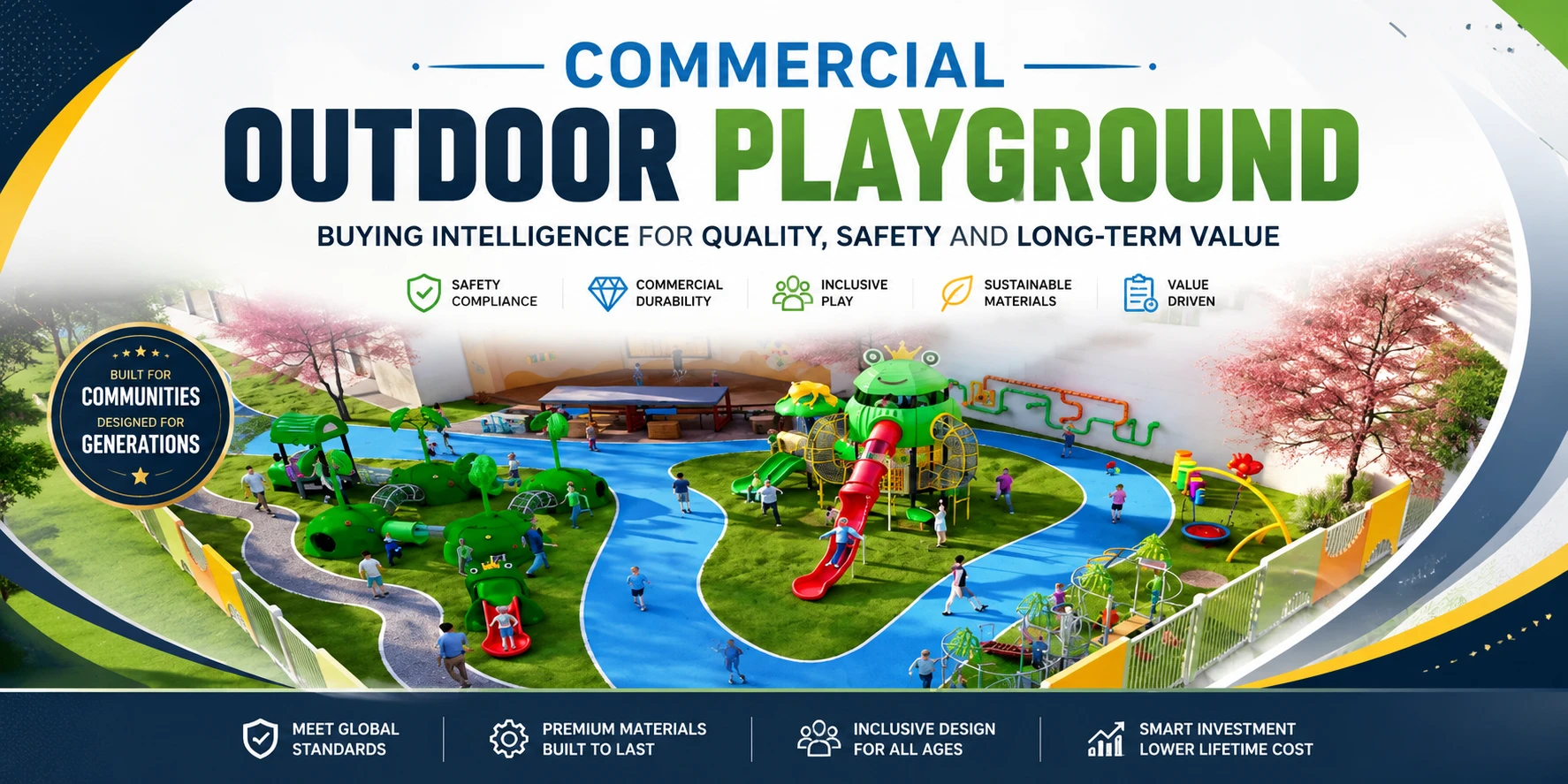
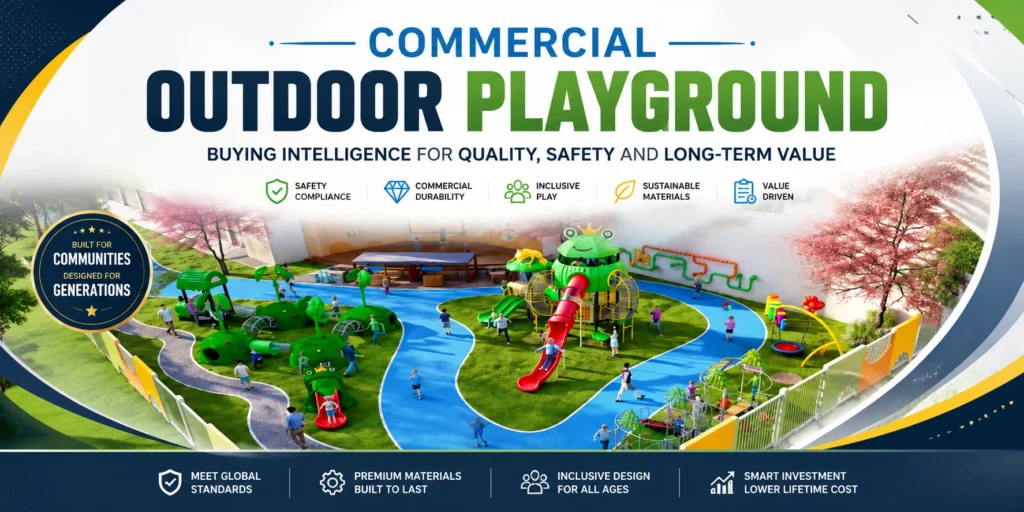
Buyers sourcing commercial outdoor playgrounds face a fragmented market where quality, safety, and price signals vary widely. A low quote may hide thinner steel posts, inferior coatings, or missing test reports.
Commercial outdoor playground equipment is heavy-duty play structures designed for public use in parks, schools, and communities, engineered to withstand high traffic, weather, and safety regulations. This guide breaks down product categories, materials, compliance, and cost drivers to help procurement teams evaluate factory proposals systematically.
Commercial Outdoor Playground Equipment Categories by Application
Supplier catalogues follow a “Products by Category” layout, often with four core categories of playground equipment: towers, slides, climbers and swings. Spinners, sensory play, inclusive access and safety surfacing complete a commercial specification.
- Modular play towers — multi-level decks, bridges and slides; parks and schools; ages 2-12; deck height sets fall height.
- Standalone slides — freestanding, compact retrofits; ages 3-12; exit-zone clearance.
- Climbers — nets, arches, rock walls; schools; ages 5-12; falls up to 3 m.
- Spinners — rotating bowls; ages 2-12; low fall height, wide radius.
- Swings — cradle, belt and tyre seats; ages 2-12; front-and-back clearance.
- Sensory playgrounds — tactile and musical panels; early years; low fall height.
- Inclusive access equipment — ramps and transfer platforms; all ages; low fall height.
- Safety surfacing — poured rubber, tiles or loose-fill; sets fall-height compliance.
Category choice fixes layout before budget: swing zones and fall footprints consume space, while towers add play capacity per square metre. A commercial playground manufacturer China will quote towers, surfacing and installation as separate line items.
Materials and Components That Define Commercial-Grade Durability
Steel posts set the baseline. Galvanised steel with a powder-coated top coat resists corrosion far better than painted tube; ask for the zinc coating weight in grams per square metre. Below 600 g/m², expect coating failure within a decade on humid coastal sites.
Aluminium decks remove the corrosion risk steel platforms face at welded joints. Rotomolded plastic panels and HDPE boards require UV stabilisers — look for an explicit UV-resistance rating, not vague weatherproof claims. Wall thickness separates commercial from residential: 6 mm HDPE survives impact where 4 mm cracks.
Stainless steel hardware, grade 304 minimum, protects fasteners at pinch points. Surfacing, whether poured rubber or tiles, needs a stated critical fall height. When a playground factory Wenzhou sends samples, scratch the coating, flex a panel, weigh the fixings. Then ask: “What is the expected lifespan of the coating?” and “What load-bearing rating applies?”
Safety Standards and Testing Evidence for Imported Play Structures
Standards dictate which test evidence you must request. ASTM F1487 applies to North America; EN 1176 covers Europe; local guidelines may add stricter rules. Each framework addresses the same hazard zones — entrapment, protrusions, crush points, fall height and surfacing impact attenuation — but pass criteria differ.
Work through this checklist before you commit to a commercial outdoor playground supplier:
- Align standards per target market — confirm the standard for your destination country, not the factory’s home market.
- Verify test lab credentials — labs should hold ISO 17025 accreditation and test to the current edition of the standard.
- Inspect factory test records — demand batch-level reports, not one certificate recycled across every model, plus traceable raw material certificates such as steel grade and plastic resin.
- Require surfacing specifications — impact attenuation data must match your chosen surfacing and the unit’s critical fall height.
Skip these checks and you inherit liability for inspection failures at customs or on site.
Cost Drivers and Budget Planning for Commercial Outdoor Playground Projects
Equipment price is only the first line item. A standalone slide or climber typically runs from £5,000 to £15,000, while a multi-tower modular system with decks and inclusive access can reach £80,000–£250,000 once shipping and import duties are added. Safety surfacing is the second major cost: loose-fill engineered wood fibre costs £3–£7 per square foot, rubber tiles sit mid-range, and poured-in-place rubber offers the best fall protection at £10–£15. Site preparation, installation and ongoing inspection make up the rest.
Keep costs in check with modular designs you can extend later, volume purchasing, in-stock components, and early coordination with a local installer. Commercial-grade units cost two to three times more than residential sets, but heavier posts, UV-stabilised plastics and replaceable parts justify the premium through a 15–20 year service life and fewer repairs. Ask for a lifecycle cost model, and use your playground equipment factory audit to confirm the playground production line can maintain consistent quality.
About JQ Playground – wenzhouplaygroundmanufacturer.com
JQ Playground (Wenzhou Jiqi Amusement Equipment Co., Ltd.) is a children’s playground equipment manufacturer founded in 1993. The company provides design, customization, large-scale manufacturing, sales, installation guidance, and after-sales support for outdoor playgrounds, indoor playgrounds, soft play, water playgrounds, PE board playgrounds, kindergarten furniture, outdoor fitness equipment, pet playgrounds, and playground facilities. Approved company facts include 180+ employees, a large Wenzhou production base, 20+ production lines, 55 production machines, ISO/BSCI/EN1176/EN71/ASTM/CPC/CPSIC certification references, 100+ patents, free design support, OEM/ODM capability, trial installation before shipping, export experience, and one-year quality warranty.