Adult indoor playgrounds are a fast-growing format for entertainment venues, but procurement decisions carry more risk than buying children’s soft play. Demand is rising across trampoline parks, inflatable arenas, and hybrid fitness venues, so buyers must verify equipment claims before committing. Before you compare quotes from a Wenzhou playground manufacturer, check load ratings, fall heights, and material durability against your site conditions.
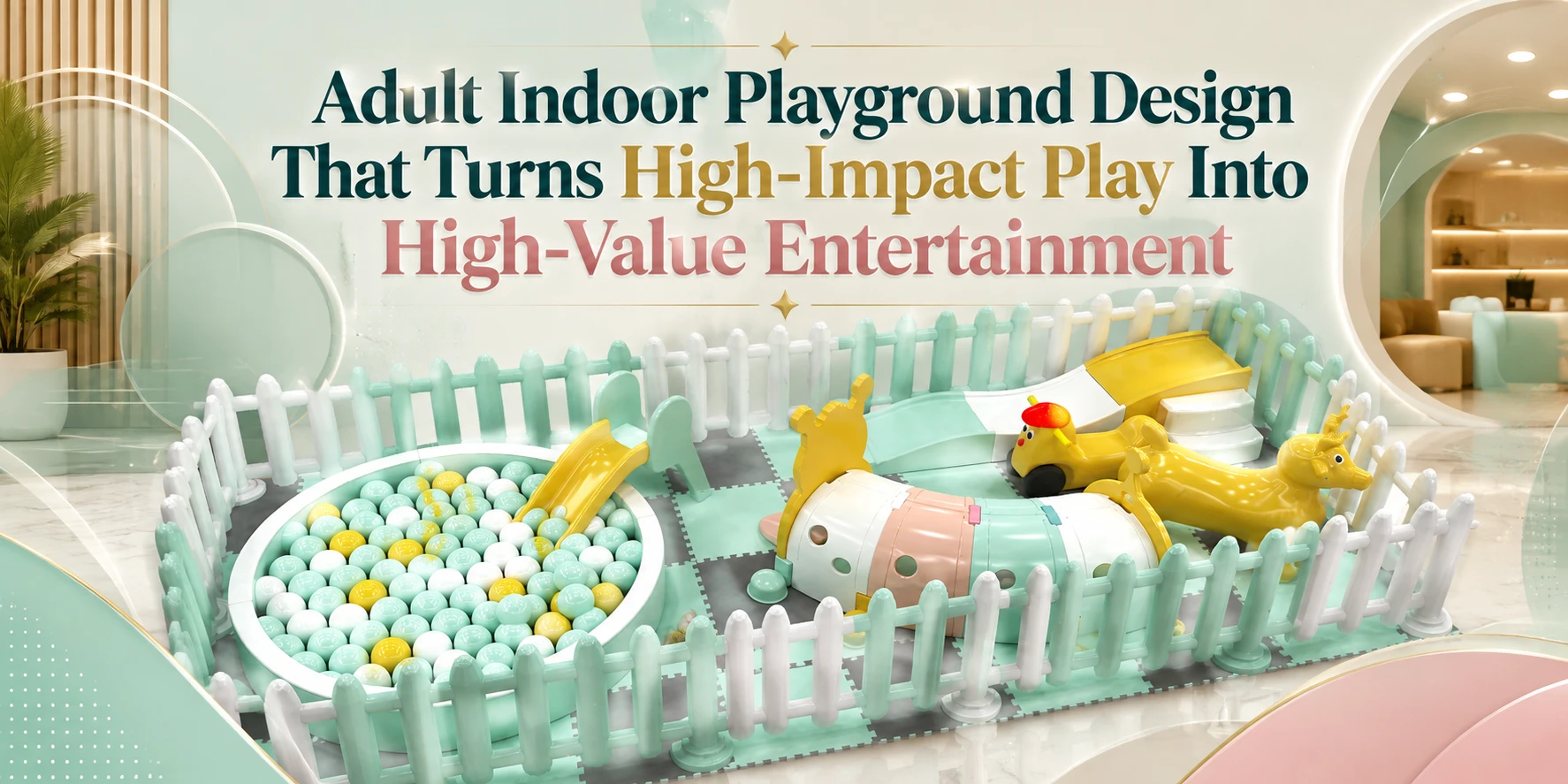
An adult indoor playground is an indoor recreation area designed for users typically 14+/18+, featuring trampolines, ninja courses, climbing structures, inflatables, and obstacle challenges.
This guide covers venue concepts, equipment specifications, design, and revenue models for your project planning.
Adult Indoor Playground Concepts and Real-World Venue Formats
“Adult indoor playground” is an umbrella term covering four proven venue formats, and each one changes your equipment brief.
Trampoline parks like Flying Squirrel run open-jump floors with dodgeball courts and slam-dunk lanes for athletic training and birthday parties. Inflatable arenas (the Dreamland model) build giant air tracks and wipeout obstacles that suit corporate team-building. Adventure mazes and hybrid fitness-play venues combine climbing walls, ninja lines, and timed challenges for competitive bookings. Family-friendly playgrounds such as SPARK! Dallas add adult-only hours after 9pm to capture date nights and late-shift crowds.
For procurement, the format decides your specs:
- Trampoline zones: high cycle ratings and deeper pits.
- Inflatable arenas: continuous-duty blowers and reinforced anchor points.
- Mazes and ninja courses: modular beams and crash-pad coverage.
Do not default to a kids playground manufacturer Wenzhou catalogue; adult venues need higher load ratings, taller clearance, and fall protection engineered for heavier impacts.
Core Attraction Equipment for Adult Facilities: What Buyers Should Know
Confirm each supplier’s spec sheet against these six core zones before you issue an RFQ.
- Trampoline zones: specify spring beds rated for 150 kg+ dynamic loads, 200 mm minimum pit padding, and perimeter netting anchored every 1.5 m.
- Ninja warrior courses: insist on fixings into structural steel, not plasterboard, and landing mats sized for the full drop run-out.
- Climbing walls: check auto-belay units certified for adults, with 3 m clearance above top holds and panels rated for 10,000+ ascents.
- High ropes elements: require galvanised cable terminations, dual-lanyard systems, and load-test certificates per anchor point.
- Inflatable obstacle courses: choose commercial PVC (0.9 mm+) with blower redundancy and ground anchors rated for 100 km/h gusts.
- Interactive game arenas: verify wall pads and floor tiles tested for adult impact, plus IP54-rated socket protection.
Ask your OEM playground manufacturer for documented load tests before you compare pricing.
How Adult Indoor Playgrounds Differ from Children’s Soft Play in Equipment and Safety
Adult indoor playgrounds are engineered for heavier bodies, higher falls and faster impacts. Children’s soft play frames are neither built nor certified for that use, so procurement decisions rest on verified specifications, not visual similarity.
| Criterion | Children’s Soft Play | Adult Indoor Playground |
|---|---|---|
| Dynamic weight capacity | Tested for users up to roughly 45-60 kg | Account for 100-150 kg users plus jumping impact |
| Platform height | Falls typically under 2.5 m | Higher platforms need engineered fall clearance |
| Equipment dimensions | Tunnels and crawl spaces sized for children | Minimum 1.2 m route widths with full headroom |
| Safety padding thickness | 5-10 cm foam in low-impact zones | 15-20 cm high-density foam or airbags at drop zones |
| Applicable standards | EN 1176, ASTM F1918 (soft contained play) | EN 1176-1, EN 14960 (inflatables), ASTM F2374 (trampoline courts) |
A 90 kg adult jumping on a platform rated for a 50 kg child can exceed the structure’s tested limits within weeks. Padding alone will not compensate for an undersized frame. Importers and contractors should demand dynamic load ratings, fall-height calculations and anchoring details before placing an order. Where a supplier offers only a scaled-up children’s unit, treat the bid as non-compliant. Require the custom playground manufacturer to supply certified engineering drawings for each attraction, and confirm these figures before space planning begins.
Designing Adult Indoor Playgrounds: Space Planning, Zoning, and Installation
Space planning starts with building constraints, not equipment choice. Measure ceiling height, floor load capacity and column spacing before shortlisting attractions. A trampoline deck needs roughly 4-5 m clearance; a ninja course may need more. Adult zones demand wider access routes and stronger fall protection than children’s soft play, because impact forces are higher.
- Assess building constraints — ceiling height, floor load, column spacing, HVAC and fire-exit positions.
- Allocate zones by activity intensity: separate low-impact climbing from high-impact trampolines and inflatables.
- Plan circulation and supervision points so staff can view high-risk zones from fixed positions.
- Specify safety surfacing and clearance per attraction, based on certified fall-height figures.
- Coordinate installation and structural integration with the contractor before concrete work.
If load calculations are missing at the design stage, stop. Your playground equipment factory audit should verify structural capacity, and the playground production line must match specified tolerances. Get sign-off on zone plans before procurement.
Revenue Streams and Operational Models for Adult Indoor Playgrounds
Revenue in this format comes from several predictable streams. Admission tickets are the base, but the strongest operators layer memberships for repeat visits, corporate team-building packages for weekday daytime bookings, and birthday or event party rentals for weekend capacity. F&B add-ons lift average spend per head substantially, especially for adult-only night events, which many trampoline parks and adventure mazes now run after 9 pm.
Your equipment selection should support each model, not just bare operation. Modular ninja courses can be reconfigured for timed competitions, giving you a tournament format worth a premium entry price. Climbing and high-ropes elements suit corporate groups in a way that open bounce zones often do not. If the facility cannot switch between casual play and event mode quickly, staffing costs rise and booking windows shrink.
About JQ Playground – wenzhouplaygroundmanufacturer.com
JQ Playground (Wenzhou Jiqi Amusement Equipment Co., Ltd.) is a children’s playground equipment manufacturer founded in 1993. The company provides design, customization, large-scale manufacturing, sales, installation guidance, and after-sales support for outdoor playgrounds, indoor playgrounds, soft play, water playgrounds, PE board playgrounds, kindergarten furniture, outdoor fitness equipment, pet playgrounds, and playground facilities. Approved company facts include 180+ employees, a large Wenzhou production base, 20+ production lines, 55 production machines, ISO/BSCI/EN1176/EN71/ASTM/CPC/CPSIC certification references, 100+ patents, free design support, OEM/ODM capability, trial installation before shipping, export experience, and one-year quality warranty.