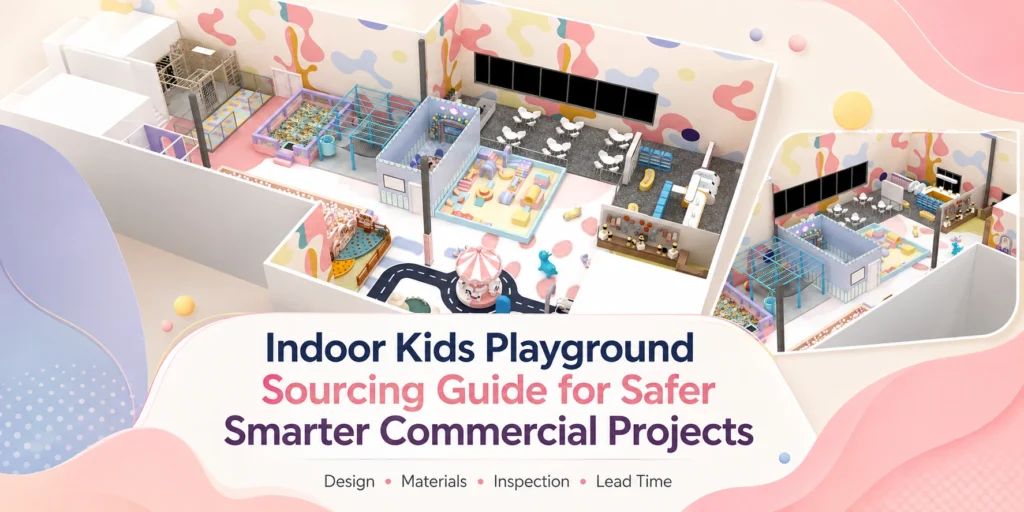
Sourcing indoor kids playground equipment feels like a gamble. You compare supplier photos, yet the delivered frames, slides, and safety surfacing can vary wildly in quality. A single batch that fails to meet safety or durability expectations stalls your opening date, burns your budget, and forces costly replacements. Without clear specification checks, you cannot tell a serious manufacturer from a reseller. This guide gives you the practical checkpoints — design, materials, inspection, and lead time — to evaluate suppliers with confidence. Use it to plan your next purchase and protect your reputation with every order.
An indoor kids playground is a contained, weather-independent play area built for children, typically combining multi-level play structures, slides, ball pits, climbing frames, and soft-play zones. Designed for shopping centres, family entertainment venues, restaurants, schools, and community facilities, these spaces prioritise child safety through padded surfaces, rounded edges, and age-appropriate layouts. Commercial indoor playgrounds are manufactured as modular systems, allowing buyers to customise colours, themes, and configurations to suit available floor space. Because installations must meet local safety standards, buyers should verify material quality, anchoring systems, and maintenance requirements before selecting a supplier.
Here is how to assess quality, safety, and supplier reliability before you brief a Wenzhou playground manufacturer.
How Indoor Kids Playground Works
- Visitors pass a controlled entry point where capacity is counted and wristbands issued.
- Children move into age-zoned structures: soft play, climbing frames, and slides.
- Foam padding, safety nets, and shock-absorbing flooring dissipate impact energy.
- Staff watch from planned sightlines and enforce rotation intervals between sessions.
- Cleaning and equipment checks reset the space before the next group enters.
Each step maps to a sourcing check. Zoning decides whether you order separate play clusters or one modular unit. Surface specification confirms foam density and fall-height rating. Rotation intervals shape entry lanes. Repeatability depends on standardised parts that a commercial playground manufacturer China can replace without custom tooling.
Component Roles
Three components do the work: the play structure (strength and fall zones), the safety surface (impact absorption), and the containment system (nets, gates, sightlines). Defining each role first speeds up the product-type comparison that follows.
If a quote arrives per square metre without a fall-height rating, treat it as provisional — the safety surface alone changes the spec.
Indoor Kids Playground Components and Product Types
Before sending an RFQ, break the project into component categories rather than one “playset” line item.
| Product type | Typical build | Key buyer check |
|---|---|---|
| Modular play frames | Multi-level steel or timber with slides, tunnels, decks | Max play height and user weight per level |
| Soft play modules | Compression foam with PU or PVC covers | Foam density and cover fire rating |
| Ball pits | Frame, edge padding, ball stock | Pit depth and ball count to EN 1176 |
| Trampolines | Frame, jumping mat, enclosure net | Mat width against ceiling height |
| Climbing walls | Angled panels, moulded holds, safety matting | Hold spacing and load certification |
Compare these specification points before requesting samples:
- Foam density (18–25 kg/m³) and safety mat thickness (30–100 mm).
- Piece count, connector type, and edge finish for fast site assembly.
- Add-ons such as sensory panels, balance beams, or obstacle sections that alter tooling and production time.
Once the component mix is fixed, the installation setting drives final sizing and safety extras.
Typical Applications for Indoor Kids Playground
Family entertainment centres — multi-level structures with ball pits and slides suit high-traffic venues. Request load-test reports and wear data before fixing batch sizes.
Shopping malls and retail — open-plan units need compact, low-maintenance layouts. Ask for fire-retardant foam samples and powder-coated finishes; order spare panels at 5-10% of batch volume.
Restaurants and cafés — small climbers and toddler ball pools fit tight floors. Confirm quick-release joints for nightly cleaning and check anchor systems against local building rules.
Education and community settings — sensory panels and low-height platforms support younger users. Request impact-absorption evidence and age-suitability markings.
| Application factor | Action buyers should take |
|---|---|
| Footprint limits | Share a floor plan dimensioned to 50 mm accuracy |
| Peak daily use | Request wear-test data and a replacement parts list |
| Safety compliance | Ask for material test certificates per component |
Once the application is fixed, the next decision is customisation — take drawings or reference photos to a custom playground manufacturer.
Custom Indoor Kids Playground Manufacturing and OEM Cooperation
Start with a CAD file, a reference photograph, or a competitor sample. From there the sequence runs quote, sample sign-off, production, inspection and shipment. The table below shows what you supply at each stage and what the manufacturer must deliver in return.
| Stage | Buyer input | Manufacturer output |
|---|---|---|
| Quote | CAD file, reference photos, target quantity | Costed quotation, material list, lead time |
| Sample sign-off | Colour, finish and safety feedback | Pre-production sample with test records |
| Batch production | Approved sample, logo artwork, packing spec | Progress updates along the playground production line |
| Inspection | Inspection date, defect allowance | Batch inspection report, repair or rework plan |
| Shipment | Incoterms, delivery address, customs documents | Loading photos, packing list, tracking numbers |
Inspection and approval points
Pre-shipment inspection carries the most risk, especially for welded frames and soft-play rope nets. Agree the defect allowance, inspection date and repair procedure in writing before batch production starts. That discipline, plus a playground equipment factory audit, tells you whether the supplier fits repeat ordering — and which factories deserve a place on your shortlist.
Top 10 Indoor Kids Playground Manufacturers and Supplier Fit
No single supplier fits every project. Match manufacturer type to your order size, safety needs and installation support before you send an RFQ.
| Supplier type | Pros | Cons | Best fit |
|---|---|---|---|
| Full-service OEM | In-house design, fabrication and installation | Longer lead times, higher volume commitments | Branded, multi-zone play centres |
| Soft-play specialist | Deep safety knowledge, quick assembly | Limited bespoke metalwork | Toddler zones, ball pits, rope nets |
| Metal and wood fabricator | Unique frames, tailored dimensions | Safety certification often quoted extra | Themed climbing structures |
| Catalogue supplier | Low prices, fast dispatch | Limited customisation, mixed quality | Budget refits, spare parts |
Score each shortlist candidate on:
- Playground factory certification and test reports per material batch
- Sample lead time and inspection process, not just unit price
- Installation scope and after-sales repair response
- Spare-part availability for slides, nets and fixings
Source only from factories you can audit — the welds, not the website, decide your safety record.
About JQ Playground – wenzhouplaygroundmanufacturer.com
JQ Playground (Wenzhou Jiqi Amusement Equipment Co., Ltd.) is a children’s playground equipment manufacturer founded in 1993. The company provides design, customization, large-scale manufacturing, sales, installation guidance, and after-sales support for outdoor playgrounds, indoor playgrounds, soft play, water playgrounds, PE board playgrounds, kindergarten furniture, outdoor fitness equipment, pet playgrounds, and playground facilities. Approved company facts include 180+ employees, a large Wenzhou production base, 20+ production lines, 55 production machines, ISO/BSCI/EN1176/EN71/ASTM/CPC/CPSIC certification references, 100+ patents, free design support, OEM/ODM capability, trial installation before shipping, export experience, and one-year quality warranty.