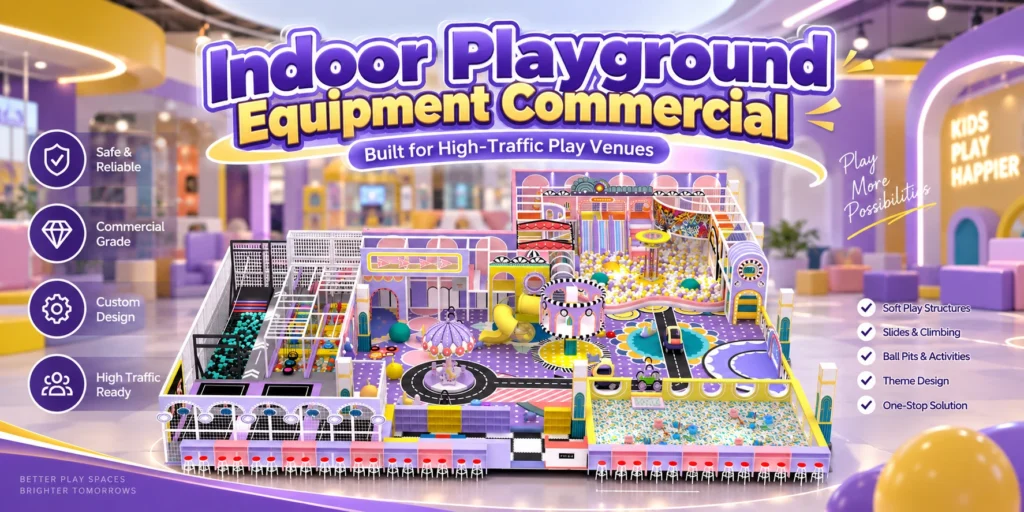
Outfitting a soft play centre, trampoline park or shopping-mall kids’ zone comes with tight deadlines and tight budgets. Residential-grade sets look identical in photos, yet commercial equipment must handle 300 visitors a day, repeated sanitising and public-liability inspection. Choose wrong and you face closure for safety failures plus refit costs that erase your margin. The solution is specification-led buying: define what commercial-grade truly means before you accept any quote.
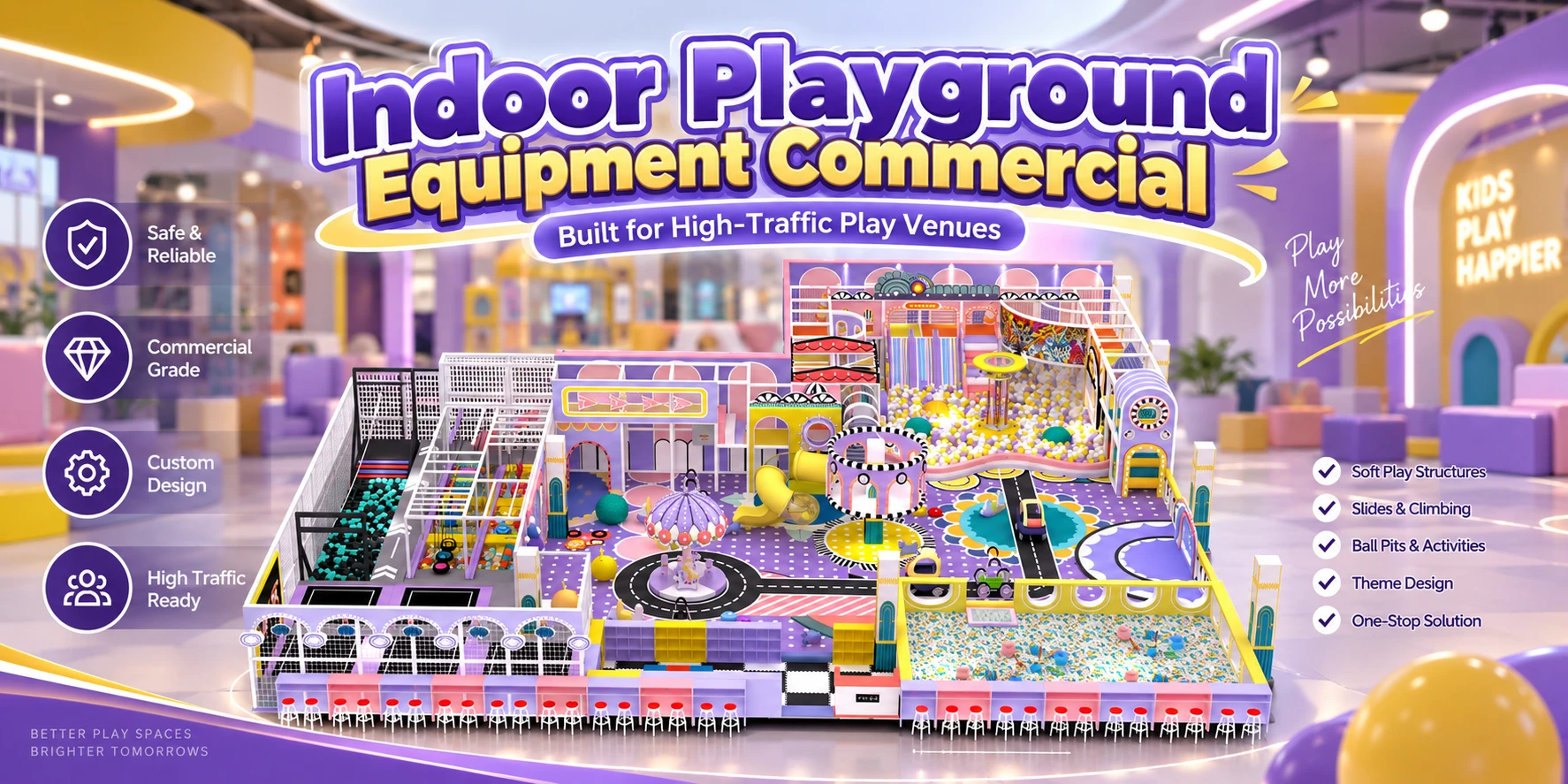
Indoor playground equipment commercial describes heavy-duty play structures for revenue-generating venues: soft play frames, slides, ball pits, climbing walls and activity panels. The build spec covers age range, fall height, floor area and visitor capacity, using fire-retardant foam, shatter-resistant HDPE and closed-stitch vinyl rated for daily cleaning and long operating hours. Unlike residential sets, commercial units carry documented load tests, anti-trap spacing checks and spare-part support so operators meet insurer and inspector requirements over a full service life.
Next, trace how commercial units are engineered, inspected and quality-checked before shipment.
How Indoor Playground Equipment Commercial Works
A commercial soft play unit is a contained circuit. Children climb, crawl and slide between connected levels while impact-absorbing mats, netting and barriers manage falls. The principle is straightforward; sourcing it correctly is not.
- Survey – measure ceiling height, door widths and usable floor footprint.
- Specify – match platform heights, slide angles and fall zones to the target age range.
- Assemble – bolt the frame, lock panels and netting, then fit foam and vinyl covers.
- Verify – check anchor torque, gaps and matting depth before opening to the public.
Component Roles
Frames carry the structural load; high-density foam absorbs energy; PVC covers resist cleaning chemicals and tears. Every part is replaceable, so confirm that spare covers, connectors and netting stay available for repeat orders.
Buyers often source from a commercial playground manufacturer China and see installation drawings only after payment. Ask for layout approval and load data before your RFQ stage.
Indoor Playground Equipment Commercial Components and Product Types
With layout and load data signed off, the next decision is component mix. Commercial indoor playgrounds typically combine five product types:
| Component type | Primary role | Buyer check before RFQ |
|---|---|---|
| Soft play modules | Toddler crawling, rolling and sensory play | Foam density; zip-off washable covers |
| Slides | High-traffic descent routes | Rotomoulded HDPE or fibreglass; smooth run-out |
| Climbing structures | Physical challenge for older children | Post spacing, grip texture, fall-height rating |
| Ball pits and accessories | Imaginative and motor-skills play | Ball count per square metre; ball material hygiene |
| Safety matting and flooring | Impact absorption beneath elevated units | Mat thickness matched to rated fall height |
Fix these details in your specification before requesting quotes:
- Age range per zone, since it controls gaps, platform heights and access points.
- Dimensions, colours and decorative panels if you need a consistent visual identity.
- Replacement-part supply; slides, mats and balls wear fastest in busy sites.
- Modular bolt-together versus welded frames, which affects future reconfiguration and shipping cost.
The right mix shifts noticeably between a toddler café and a family entertainment centre.
Typical Applications for Indoor Playground Equipment Commercial
Venue type dictates the specification before price does, so group your sourcing by where the equipment will operate.
- Family entertainment centres run high-rotation, multi-level play. Ask for abrasion-resistance data on mats and foam-density specs before batch confirmation.
- Nursery and preschool settings suit low-height modular units with sensory panels. Request EN 1176 or ASTM F1918 evidence per delivered batch.
- Food-service venues need compact, wipe-clean zones. Specify antimicrobial cover material and time reorders to annual refurb cycles.
- Sports centres and trampoline parks blend climbing frames with soft-fall flooring. Check impact-attenuation reports against your floor depth.
| Application factor | Buyer action |
|---|---|
| Age range | Zone play to the correct safety class |
| Daily throughput | Build spare parts into batch volumes |
| Building footprint | Request fit drawings before quoting |
Once these checks are settled, a custom playground manufacturer can turn the venue constraints into a production-ready layout.
Custom Indoor Playground Equipment Commercial Manufacturing and OEM Cooperation
With the layout agreed, the next test is whether the supplier can replicate that result across a full order. A stage-gated process keeps both sides accountable.
| Stage | Buyer input | Manufacturer output |
|---|---|---|
| Quotation | Dimensioned drawings or reference samples, floor plan, target quantities | Feasibility check, material notes, itemised quote |
| Sample confirmation | Approved colours, logos, layout edits | Updated drawings and confirmed sample build |
| Production and batch inspection | Agreed checklist covering welds, foam density, seams | Mid-production updates, pre-shipment inspection report |
| Packaging and shipment | Shipping marks, port, delivery terms | Export-grade packaging, loading plan, shipping documents |
Ask for a pre-dispatch playback against the sample before crates close. That one checkpoint exposes most quality drift. A disciplined playground production line shows up in repeatable welds and consistent covers — the same evidence you can use to compare factories later.
Top 10 Indoor Playground Equipment Commercial Manufacturers and Supplier Fit
Top 10 lists vary by market, so judge shortlists against your project type. Four supplier profiles dominate commercial indoor playground RFQs: full-range manufacturers, modular soft-play specialists, custom OEM workshops, and high-volume economy lines. Match the profile before comparing prices.
| Supplier type | Pros | Cons | Best fit |
|---|---|---|---|
| Full-range manufacturer | Wide catalogue, stocked spare parts, consistent export packaging | Slower custom requests; rigid minimums | Operators needing one supplier for slides, nets, and soft play |
| Modular soft-play specialist | Faster installation, reconfigurable layouts, safety-tested joints | Premium price per square metre | Cafés, retail play areas, rental fleets |
| Custom OEM workshop | Your drawings become bespoke units; flexible batch sizes | Longer design lead times | Themed projects and branded centre fit-outs |
| High-volume economy line | Low unit cost, standard sizes, rapid dispatch | Thinner foam and covers; verify compliance paperwork | Budget projects and short-notice refits |
Score every candidate on the same criteria before requesting samples:
- Playground quality control records, including weld and seam inspection photos
- Playground factory certification evidence or third-party audit reports
- Samples matching the quoted foam density, colour, and netting type
- Delivery slots confirmed against your fit-out or opening schedule
- Realistic inspection windows that fit your approval timetable
Sourcing principle: the cheapest factory only looks cheap before the first safety audit.
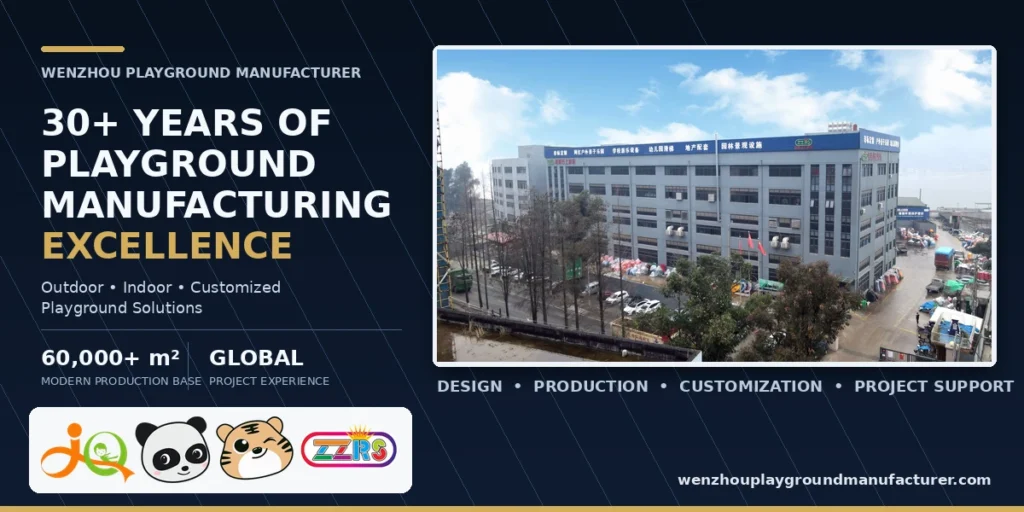
About JQ Playground – wenzhouplaygroundmanufacturer.com
JQ Playground (Wenzhou Jiqi Amusement Equipment Co., Ltd.) is a children’s playground equipment manufacturer founded in 1993. The company provides design, customization, large-scale manufacturing, sales, installation guidance, and after-sales support for outdoor playgrounds, indoor playgrounds, soft play, water playgrounds, PE board playgrounds, kindergarten furniture, outdoor fitness equipment, pet playgrounds, and playground facilities. Approved company facts include 180+ employees, a large Wenzhou production base, 20+ production lines, 55 production machines, ISO/BSCI/EN1176/EN71/ASTM/CPC/CPSIC certification references, 100+ patents, free design support, OEM/ODM capability, trial installation before shipping, export experience, and one-year quality warranty.