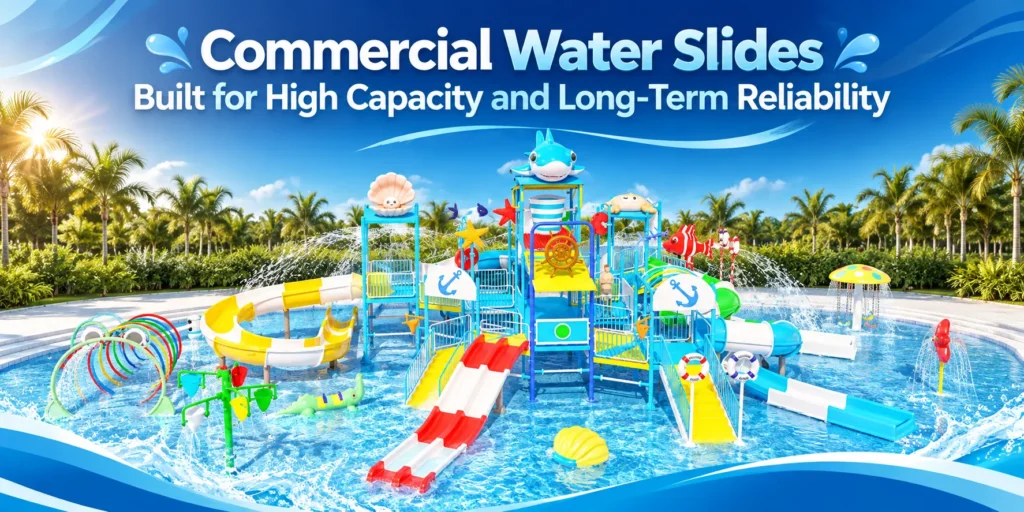
Ordering commercial water slides without a written specification is how projects lose money. A 12-metre slide rated for 60 riders an hour looks fine until a venue books 200 on a Saturday. Queue times climb, staffing doubles, and the unit sits idle for weeks waiting on a replacement bladder. Most failures trace back to three unchecked details: rider capacity, anchor and blower ratings, and whether a supplier can repeat the same build next season. Sort those before you shortlist anyone.
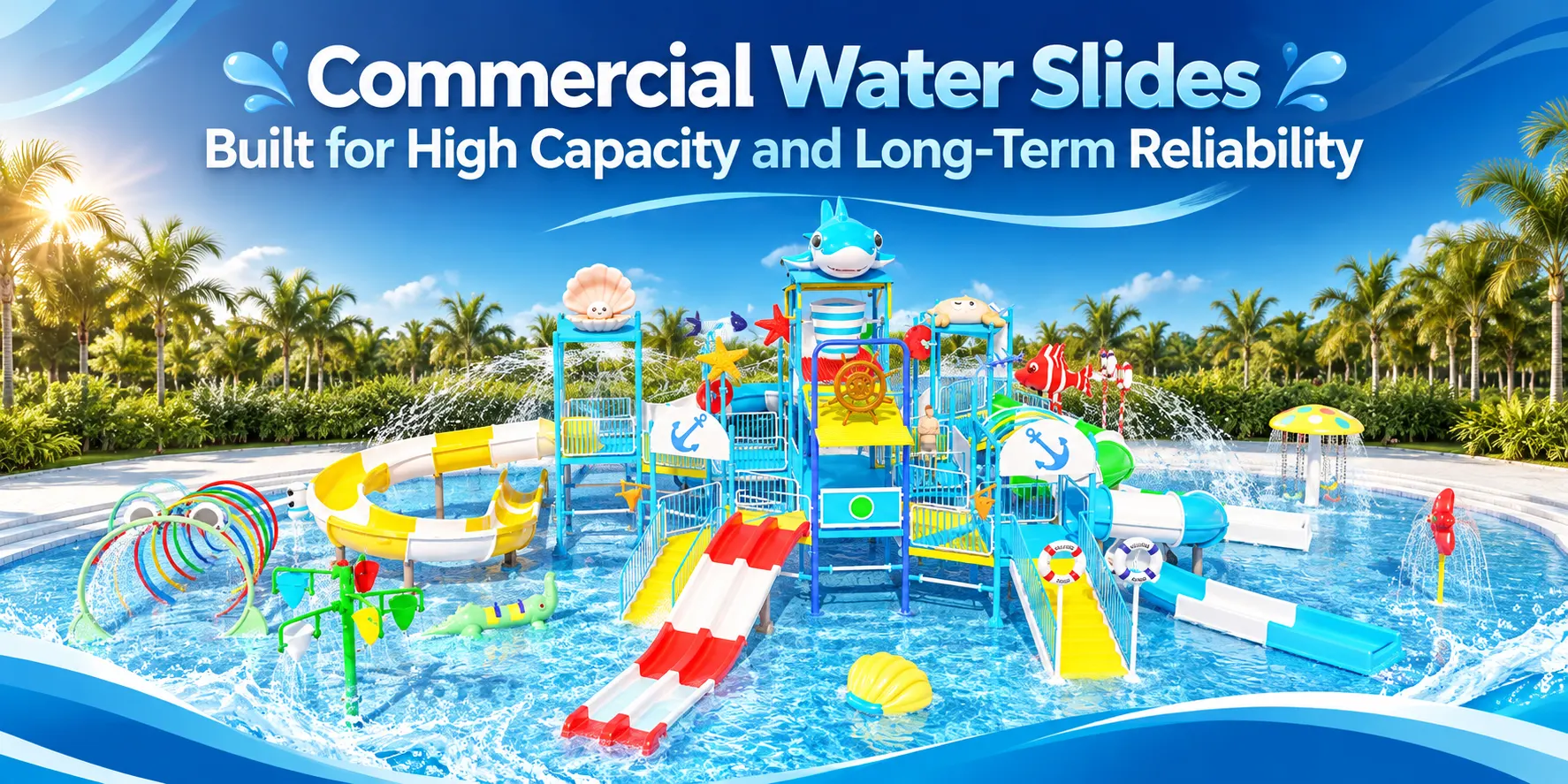
Commercial water slides are large-scale inflatable or hard-shell ride structures built for supervised, high-throughput use at water parks, resorts, camps, and rental operations. They combine a wet or dry sliding surface, an inflation or pump-driven water delivery system, and reinforced anchor points to carry multiple riders per hour. Commercial grades differ from consumer versions in fabric weight, seam construction, rider-weight limits, and documented safety checks. Sizing is quoted by slide length, drop height, lane count, and riders per hour.
The stages below explain how each part works before you compare suppliers.
How Commercial Water Slides Work
The operating principle runs in four steps, each one a sourcing check:
- Entry: riders climb to a raised platform and start at the flume head.
- Descent: a pump holds a water film, which sets speed and friction.
- Recirculation: water drains to a splash pool, is filtered, then pumped back.
- Reset: staff clear the landing zone before the next rider.
Match footprint and tower height at step 1. Inspect joint covers, rail height, and flume thickness at step 2. Under-sized pumps lose speed as visitor numbers rise, so request the duty point, not motor power alone.
Component roles
- Flume sections — sliding surface; seam quality drives wear life.
- Support frame — takes rider loads; confirm wind and soil assumptions.
- Pump and filter — control water depth and speed.
- Splash pool — braking zone; length must match exit speed.
Types of commercial inflatable water slides
Slide format drives throughput, crew pack-down time and the safety checks that matter most. Compare the main families before you request quotes.
| Type | Typical setting | Buyer check |
|---|---|---|
| Single-lane straight | School fairs, small hire fleets | Lane width 60–90 cm; wall height against age group |
| Dual-lane racing | Camps, festivals | Matched lane geometry so finish times compare fairly |
| Curved or drop slide | Higher-footfall venues | Curve radius and reinforced inside seams |
| Slide with splash pool | Pay-per-play sites | Exit angle and pool depth versus rider speed |
| Hybrid dry or wet | Year-round rental | Drainage points and removable ladder fittings |
Specification checks that shorten a shortlist:
- Material weight — confirm gsm or denier and PVC coating on both faces.
- Anchors — count tie-down points and match them to your ground fixings.
- Blower output — verify the CFM required at your slide height.
- Seam build — ask which joints are double-stitched and reinforced.
Venue footprint and rider age band usually decide which format you buy.
Typical Applications for Commercial Water Slides
Most commercial water slides fall into three buying patterns: permanent park installs, seasonal rental fleets, and single-site leisure add-ons. Each shifts deck width, anchoring method and rider throughput.
- Holiday parks and resorts: multi-lane or slide-plus-pool combos, 15–30 m runs, anchors matched to existing pumphouse layouts.
- Municipal pools and leisure centres: low freeboard and netted sides for supervised sessions; request seam-strength test evidence per unit.
- Rental and event operators: modular 6–12 m units with replaceable wear strips, plus one connector size across the fleet so a single blower set fits all.
- Schools, camps and family venues: single-lane slides sized to lower age bands; ask for material thickness and seam reinforcement details.
Ordering ten or more identical units in one run keeps specifications consistent and simplifies spares. Terminal diameter and blower connector size are the first details a custom build brief must fix.
Custom Commercial Water Slides Manufacturing and OEM Cooperation
Custom commercial water slides follow one route once tube and connector sizes are fixed. Five stages pair what you supply against what the manufacturer returns.
| Stage | You supply | Manufacturer returns |
|---|---|---|
| Brief and quote | Drawings or sample, colour, logo, quantity | Feasibility note, material spec, unit price, lead time |
| Sample confirmation | Written approval or marked changes | Pre-production sample with photos |
| Packaging | Retail or bulk format, carton markings | Packing spec, carton sizes, pallet plan |
| Batch inspection | AQL level and test checklist | Inline and pre-shipment reports |
| Shipment | Forwarder, booking, documents | Container loading list and tracking |
What Batch Inspection Should Cover
Inspection should verify seam welds, blower connector fit, and that printed colours match the approved sample. Dated reports beat verbal assurances: a playground equipment factory audit becomes a records check, and a steady playground production line keeps those records comparable across repeat orders.
Top 10 Commercial Water Slides Manufacturers and Supplier Fit
Audit trails close one gap; shortlisting closes the next. Buyers fail less on paperwork than on matching supplier type to a Commercial Water Slides project, because a 12 m fibreglass body slide and a rental-grade inflatable are not interchangeable. Score four candidate types on the columns below, then rank them against your own site plan.
| Supplier type | Pros | Cons | Best fit |
|---|---|---|---|
| Water park slide fabricators | Engineered drawings, long spans, high throughput | Tooling cost, 12–20 week lead times | Fixed installs, 500+ riders/day |
| Commercial inflatable slide makers | Fast sampling, custom colours, low tooling | Lower capacity per unit, weather exposure | Rental fleets, resorts, seasonal sites |
| Turnkey park contractors | One contract for design, install, commissioning | Less freedom to swap components | Tender buyers needing accountability |
| Distributors and trading companies | Wide catalogue, small-batch handling | Limited line-level control, slower fault tracing | Importers testing a new market |
Scoring checklist:
– Run length, height, and rider throughput against your site plan.
– Dated evidence for seams, welds, and blower connectors.
– Batch consistency under your playground quality control routine.
– Sample turnaround versus bulk production lead time.
– Spare panels, blowers, and connector availability.
Shortlist three suppliers, not ten: capacity, inspection evidence, and repeat-order consistency outweigh unit price.
Weight those scores by project scale — permanent install, seasonal rental, or first trial order.
About JQ Playground – wenzhouplaygroundmanufacturer.com
JQ Playground (Wenzhou Jiqi Amusement Equipment Co., Ltd.) is a children’s playground equipment manufacturer founded in 1993. The company provides design, customization, large-scale manufacturing, sales, installation guidance, and after-sales support for outdoor playgrounds, indoor playgrounds, soft play, water playgrounds, PE board playgrounds, kindergarten furniture, outdoor fitness equipment, pet playgrounds, and playground facilities. Approved company facts include 180+ employees, a large Wenzhou production base, 20+ production lines, 55 production machines, ISO/BSCI/EN1176/EN71/ASTM/CPC/CPSIC certification references, 100+ patents, free design support, OEM/ODM capability, trial installation before shipping, export experience, and one-year quality warranty.