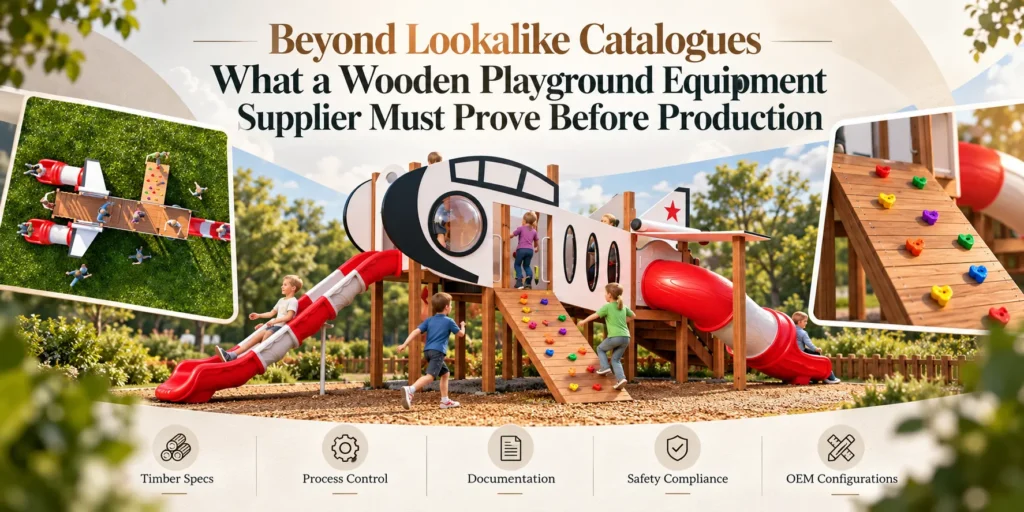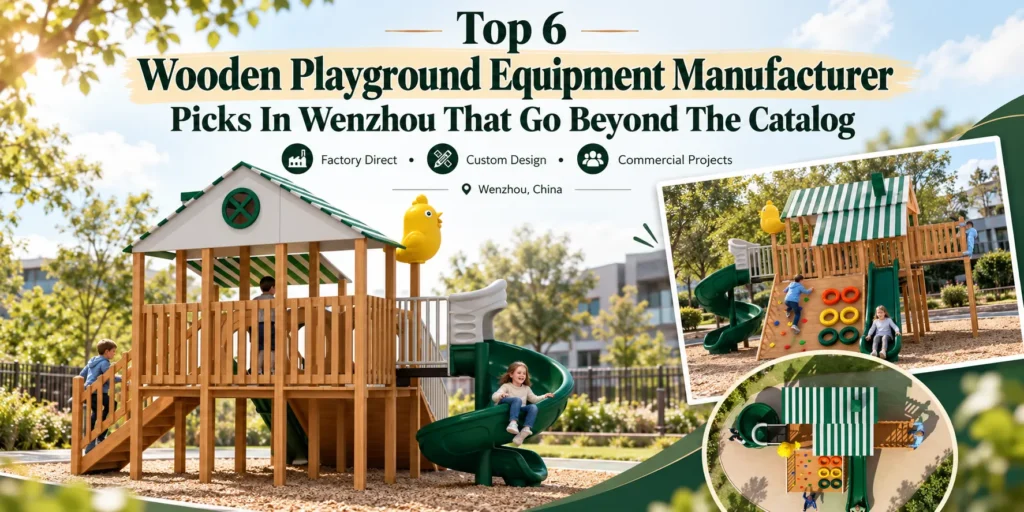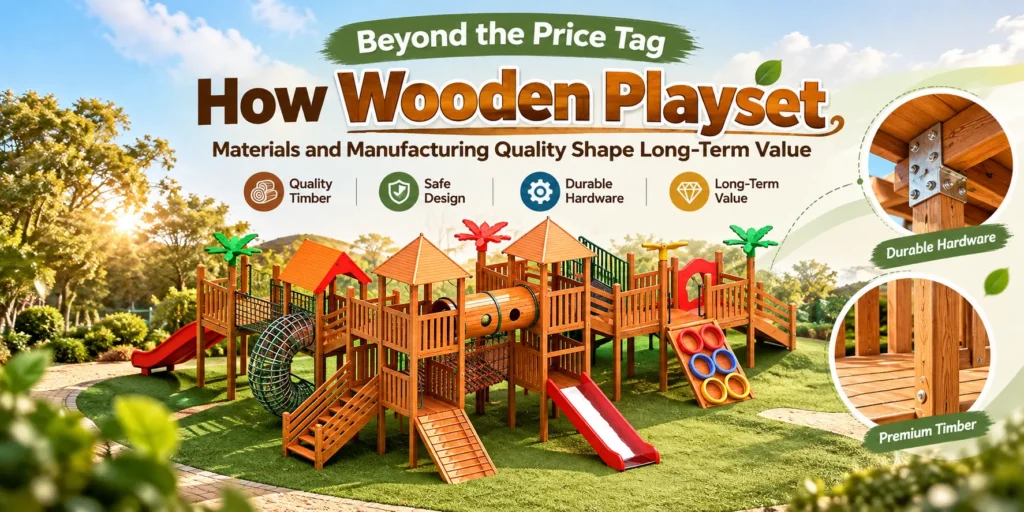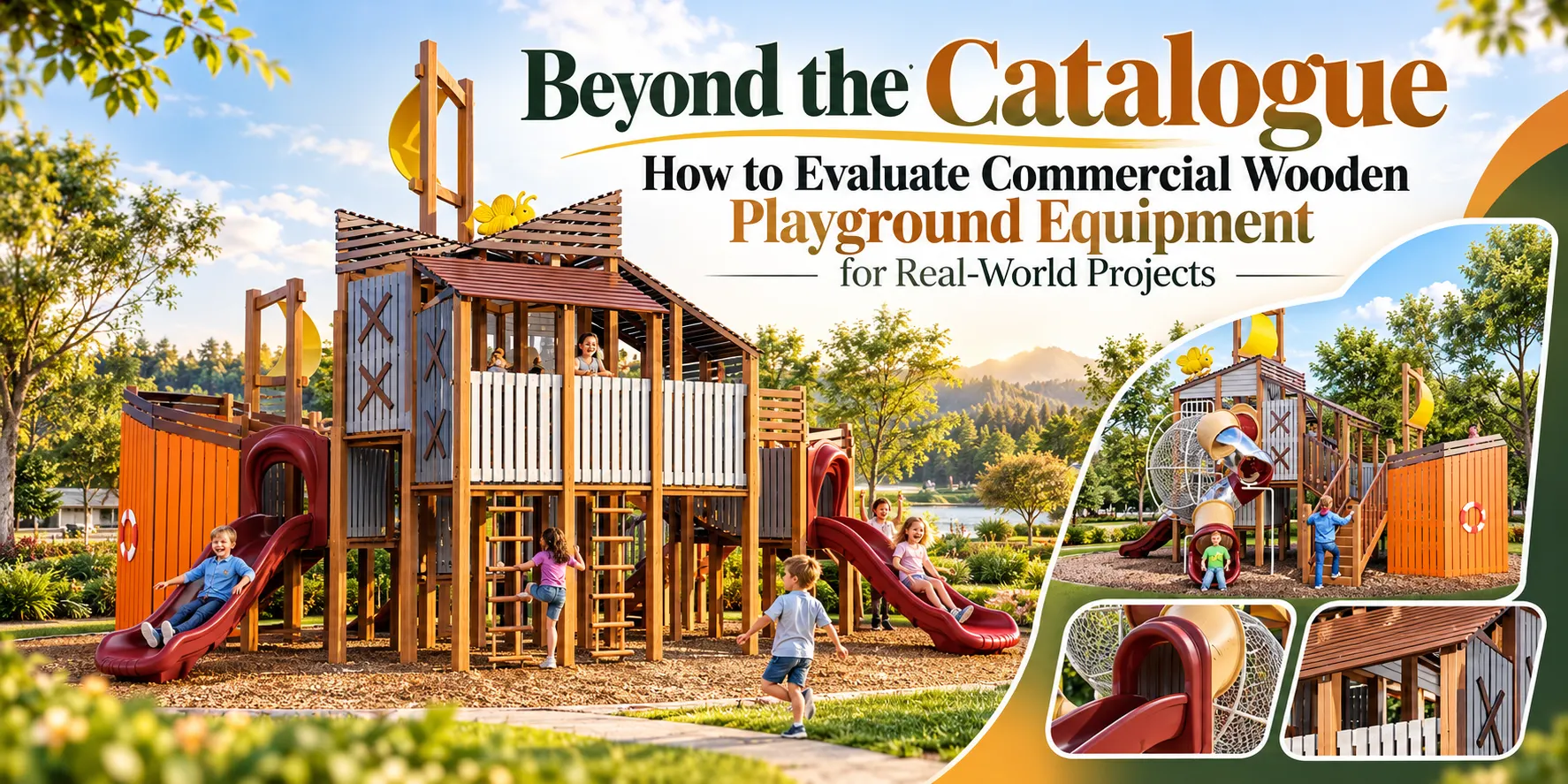
A park upgrade, a school tender or a distributor’s new range lands on your desk, and every search result for timber play is a supplier catalogue front. Before shortlisting a Wenzhou playground manufacturer, you need to read those pages the way a buyer does.
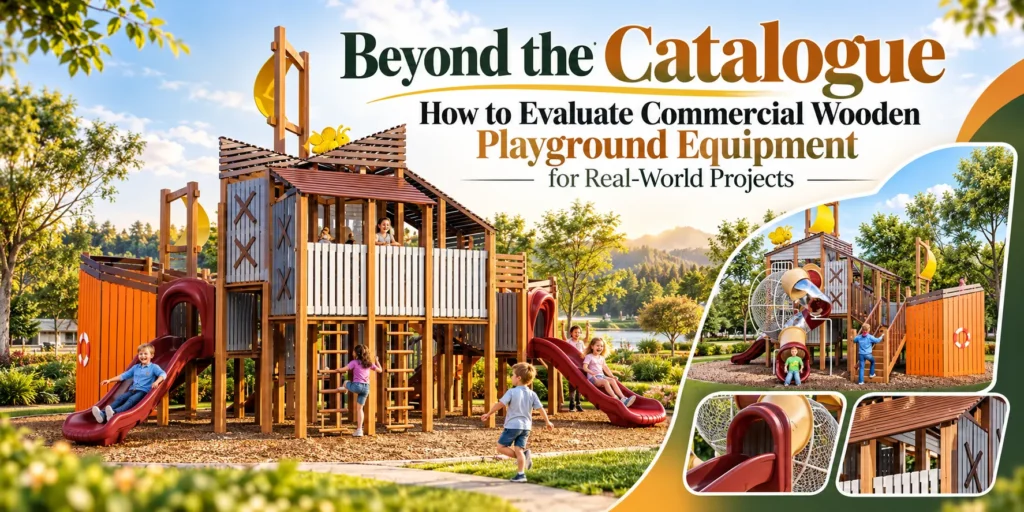
Commercial wooden playground equipment is heavy-duty, site-installed play built on a timber post-and-deck frame with HDPE or panel infill and metal fasteners, sized and rated for public or institutional daily use rather than domestic gardens.
Supplier catalogues group these ranges by structure family, component and age band, not by material, so the reading order matters.
How Commercial Wooden Playground Equipment Is Grouped Into Supplier Catalog Lines
Most supplier sites organise commercial wooden playground equipment under the same six catalogue lines:
- Main play structures and multi-deck towers
- Freestanding components sold individually
- Themed structures
- Inclusive ranges
- Surfacing
- Park amenities such as shade, seating and tables
Wooden ranges rarely get a standalone ‘wooden’ category. They sit inside ‘play structures’ and ‘freestanding play’, so read the material column or spec sheet line by line. Across competitor catalogues, the hub pattern repeats: age-band hubs (2–5, 5–12), component hubs, and themed or inclusive hubs. Treat these as navigation aids, not proof of timber content. That column is the first filter before species and hardware comparisons.
Timber Species, Panel Systems and Hardware That Distinguish Commercial-Grade Wooden Structures
Commercial wooden playground equipment should be specified by service life, not a species name alone. Ask for pressure-treated pine, robinia, cedar or heat-treated/laminated timber, with treatment class, moisture content, post dimensions (for example 90 × 90 mm or 120 × 120 mm) and 28–38 mm deck boards stated on the spec sheet.
Timber and Panel Choices
Compare 12–18 mm HDPE/PE board infill against plywood or painted panels: HDPE resists moisture and splintering, while plywood needs edge sealing and repainting.
Fasteners and Wear Parts
Demand galvanised or stainless fasteners, powder-coated steel connectors and through-bolted joints, not screws alone. Capped post tops, accessible bolt heads and replaceable slides, swing seats and chains signal a repairable build. Treat any cited EN or ASTM standard as a supplier claim to verify against the test report before comparing quotes.
Age Bands and Component Families Buyers Specify in Wooden Play Systems
Supplier catalogues split wooden play systems into four published age bands, and the split is not cosmetic. Deck heights, guardrail treatment and step geometry change with each band, so a range that looks similar in a photo can be rated for very different users.
- 6–23 months. Low decks, typically under 600 mm, with full enclosures on all open sides. Ramps and wide steps replace ladders. Ground-level sensory panels do most of the work; slides are short and shallow. Fall height stays minimal.
- 2–5. Deck heights commonly 900–1,200 mm. Guardrails need infill that blocks a 89 mm probe, and barriers are specified at upper platforms. Step spacing around 200 mm with handrails on both sides. Enclosed play dominates.
- 5–12. Decks rise to 1,500–2,200 mm, and fall height becomes the controlling dimension for surfacing depth. Rung and climbing-hold spacing widens, swing bays lengthen, and open challenge elements replace enclosed platforms.
- 2–12. Shared structures where the lower deck serves younger users and the upper deck serves older ones. Separate access routes are essential: younger children should not reach the high deck through the 5–12 climbing route.
Component families follow the frame. Slides, climbers, net structures, playhouses and activity panels usually bolt directly to a deck system, sharing its posts and footings. Spinners, swing bays, balance beams and sand or water elements are normally freestanding, each with its own fall zone.
Component choice drives component count, footprint and freight volume. A three-tower configuration with two slides and a swing bay may ship as 40-plus cartons, and long slide chutes and swing frames set the container’s limiting dimension. Consolidating mixed age bands into one load rewards buyers who request carton dimensions and stackability early — a routine question for an ODM playground manufacturer quoting a multi-band range.
Themed, Inclusive and Custom Configurations for Parks, Schools and Community Sites
The same post-and-deck frame carries very different specifications once the site type changes. A destination park tolerates a taller, theme-led tower; a primary school needs ramped access and ground-level panels a wheelchair user can reach from the tarmac.
Typical application-to-configuration pairings:
- Destination parks and attractions: themed towers with roofed huts, turret cladding and motif panels, often at the upper end of the 5–12 deck height range.
- Schools and community sites: inclusive layouts with ramp gradients, transfer platforms at deck level, and sensory or activity panels mounted between 400 mm and 900 mm.
- Nature and adventure motifs: printed HDPE panel artwork and coloured post caps rather than carved timber, so damaged panels swap out without structural work.
- Custom-configured systems: buyer-supplied footprint drawings, theme references or brand colours applied to a standard module set.
For overseas buyers, custom work runs through drawing approval before production — general arrangement, then panel artwork proofs, then a signed-off layout. Most suppliers re-specify colours, panel graphics and module combinations on existing decks; fully bespoke steelwork or new moulds sit in a different cost and tooling bracket. Ask which parts are interchangeable across ranges, because that decides how much of a future order you can adjust without new drawings. Confirm the drawing approval stages in writing during any playground equipment factory audit, and check that the playground production line can hold a colour batch across repeat orders.
What Belongs in an RFQ Before Wooden Playground Quotes Can Be Compared?
A quote is only comparable when every supplier prices the same scope. Put these items in the RFQ document and require each response to address them line by line:
- Age band and capacity — state the target user group (6–23 months, 2–5, 5–12 or 2–12) and the number of children the site must hold at peak.
- Footprint and fall zone — give site dimensions, the required safety surfacing area around each structure, and any boundary constraints.
- Timber specification — species, treatment method, post dimensions and deck thickness.
- Panel and hardware grade — HDPE versus plywood infill, fastener material (galvanised or stainless), connector coating.
- Component schedule — every item listed by name with quantity, not a single lump-sum structure.
- Slide and swing detail — deck height, slide length and material, swing bay configuration, seat type and chain grade.
- Drawings — request plan views, elevation drawings and a layout file showing fall zones.
- Packing and loading — ask for carton dimensions, unit weights and how many sets fill a 20ft or 40ft container.
- Spares — which wear parts (slides, seats, chains, panels) can be ordered separately and at what interval.
- Samples — whether a timber or panel sample, or a prototype of a custom component, is possible before tooling.
- Documentation — request the material test reports, treatment certificates and inspection records that will accompany the shipment, since playground quality control evidence and playground factory certification claims should be verifiable paperwork, not catalogue badges.
Budget tiers split roughly into value-engineered ranges using standard post sizes and stock components, and heavy-duty custom builds with thicker decks and bespoke steelwork. Quick-ship or stock programmes ship from existing inventory in weeks; made-to-order structures follow drawing approval, production and finishing, so timelines extend accordingly. State which model you expect in the RFQ.
About JQ Playground – wenzhouplaygroundmanufacturer.com
JQ Playground (Wenzhou Jiqi Amusement Equipment Co., Ltd.) is a children’s playground equipment manufacturer founded in 1993. The company provides design, customization, large-scale manufacturing, sales, installation guidance, and after-sales support for outdoor playgrounds, indoor playgrounds, soft play, water playgrounds, PE board playgrounds, kindergarten furniture, outdoor fitness equipment, pet playgrounds, and playground facilities. Approved company facts include 180+ employees, a large Wenzhou production base, 20+ production lines, 55 production machines, ISO/BSCI/EN1176/EN71/ASTM/CPC/CPSIC certification references, 100+ patents, free design support, OEM/ODM capability, trial installation before shipping, export experience, and one-year quality warranty.