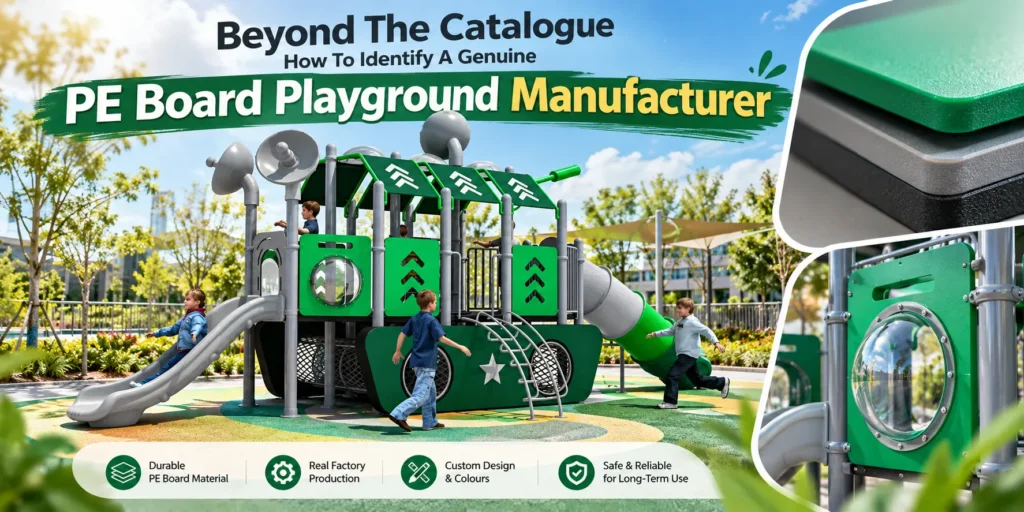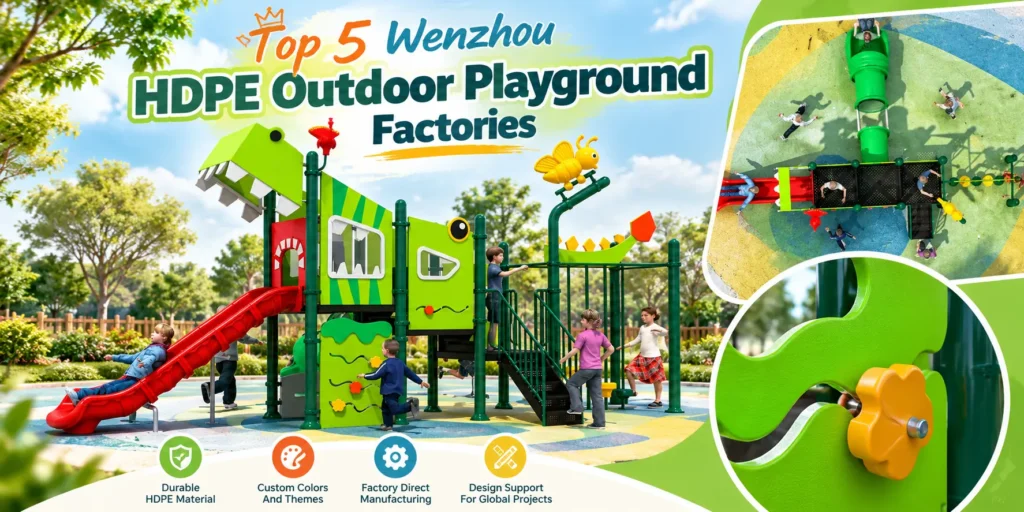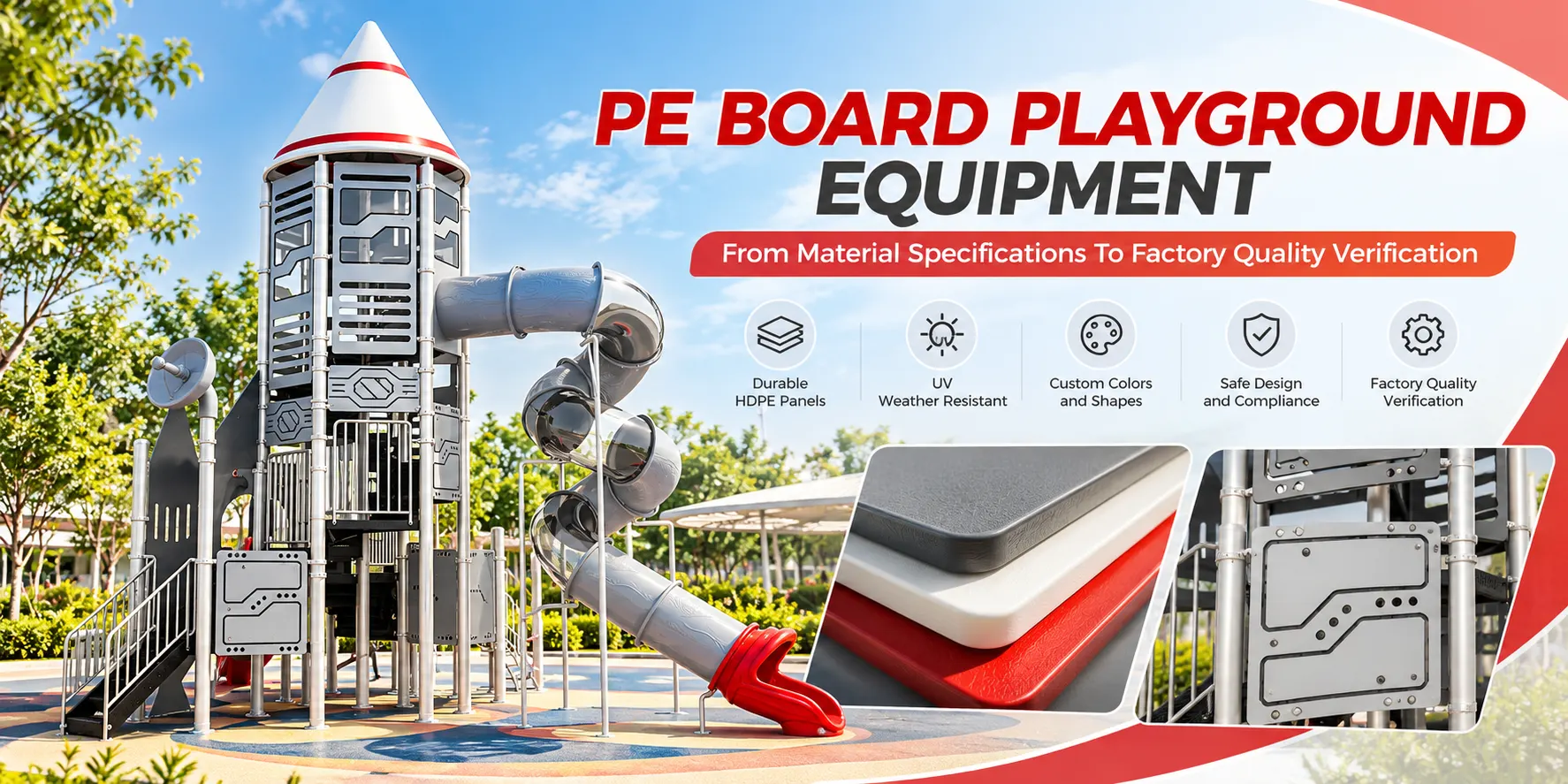
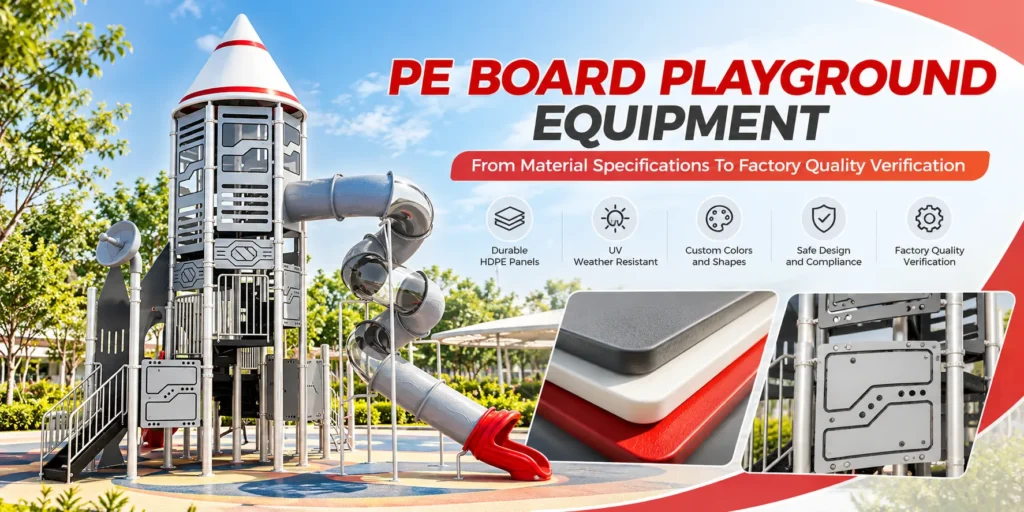
A sourcing file or tender pack lists ‘pe board playground equipment’, and you need to confirm what the phrase covers, how the panels are specified and what proof to demand before releasing an order.
PE board playground equipment refers to outdoor play structures in which high-density polyethylene panels form the play panels, activity walls, roofs, themed facades and infill surfaces fixed to steel or timber frames.
The category spans play panels, slide sides, climbers, themed facades and modular tower infill.
PE Board Playground Equipment Covers Play Panels, Slides, Climbers and Modular Towers
On supplier product pages, PE board playground equipment appears as panel-driven components, not one stock item. A commercial playground manufacturer China buyers assess typically lists each family with its own drawing and fixing schedule:
- Tic-tac-toe and gear play panels, plus activity walls
- Slide side panels, hoods and climbing ramps
- Playhouses, shop-front and themed facades
- Roof caps and modular tower infill panels
Within the finished structure, every item is non-structural cladding or an interactive surface. It fixes to galvanised steel posts, decks and clamps; it does not carry the frame. That split matters at tender stage. The steel frame takes wind and footfall loads, while the panel supplies colour, play value and a wipe-clean face.
Board Grade, Panel Thickness and UV Resistance in Outdoor HDPE Play Panels
On PE board playground equipment, all four grades are high-density polyethylene (HDPE) sheet; the core construction matters most. Single-colour board carries pigment through its full thickness, so routed grooves and scratches stay the intended colour. Capped board pairs a thin coloured skin with a contrasting core — it hides scuffs but exposes that core wherever a cutter breaks through.
| Thickness | Typical panel use | Buyer check |
|---|---|---|
| 12 mm | Decorative infill, low-touch facades | Flatness and core colour at cut-outs |
| 15 mm | Play panels, gear and maze boards | Clean routed edges, no chipping |
| 18 mm | Activity walls, shop fronts | Fixing pull-out at screw points |
| 19 mm | Slide sides, hoods, high-contact faces | Caliper reading against the drawing |
UV stabiliser loading sets fade expectations: dark reds and blues shift furthest after several summers, so request a weathering reference for the exact shade. Anti-static additives limit dust cling, while embossed textures improve grip and wipe clean of graffiti. HDPE expands in heat and stays impact-tough in cold, so specify expansion gaps on panels above 1 m.
Custom Shapes, Engraving and Colour Matching for OEM Play Panel Projects
- Profiles: send a DXF and expect CNC routing with radiused corners — internal radii of 15–25 mm resist stress cracking better than square notches on 12–15 mm board.
- Graphics: engraving cuts into the coloured core and survives scrubbing; UV print sits on the surface and dulls with repeated cleaning; sublimation dyes the cap layer and holds fine line art.
- Colour: match to RAL or Pantone chips, then approve a physical sample, because one code can shift between board batches.
- Play value: maze walls, shop fronts, animal silhouettes and letter panels turn a plain tower into a themed unit.
A worked brief: a 1.5 m tower with a shop-front panel, 300 mm letter cut-outs along the roof line and two animal silhouette infills in 15 mm board — detail enough for a custom playground manufacturer to quote panel by panel. Supply vector artwork, colour references, panel dimensions and fixing-point layout.
How Are Edge Treatment, Entrapment and Fall Height Checked on PE Board Panels?
Check cut edges first: every routed profile and drilled hole should be radiused, deburred or chamfered, with no sharp corner, whisker or splintering where a hand can reach. Then run finger-trap and head-entrapment probes on panel-to-post gaps and cut-outs, and confirm no fixing can be reached or loosened from the play side. Panel height matters too — a panel at platform level sits inside the fall height used to size surfacing beneath the structure. Expect these documents with the equipment:
- EN 1176 series test reports
- ASTM F1487 assessment
- Coating and heavy-metal test references
- Salt-spray results for fixing hardware
Request the reports before releasing the order, and keep the playground equipment factory audit trail with them.
Supplier Evidence to Collect: Material Samples, Thickness Checks and Container Loading
Close the loop on that audit trail by building a pre-shipment evidence file. Request seven items:
- A physical board sample in the ordered thickness and colour — confirm core colour and surface texture against the approved swatch.
- A caliper reading taken at pre-shipment inspection and recorded against the panel drawing; a 15 mm callout should measure 15 mm, not 13.8 mm.
- Dated QC photos of cut edges, drilled holes and hardware packs, tied to the batch.
- Trial assembly of one panel set to its frame before bulk packing.
- Packing detail: edge protection, film wrap and separating sheets between panels to prevent transit scuffing.
- A container loading plan showing how panels nest against steel posts.
- Export paperwork: packing list, material declaration and inspection report.
About JQ Playground – wenzhouplaygroundmanufacturer.com
JQ Playground (Wenzhou Jiqi Amusement Equipment Co., Ltd.) is a children’s playground equipment manufacturer founded in 1993. The company provides design, customization, large-scale manufacturing, sales, installation guidance, and after-sales support for outdoor playgrounds, indoor playgrounds, soft play, water playgrounds, PE board playgrounds, kindergarten furniture, outdoor fitness equipment, pet playgrounds, and playground facilities. Approved company facts include 180+ employees, a large Wenzhou production base, 20+ production lines, 55 production machines, ISO/BSCI/EN1176/EN71/ASTM/CPC/CPSIC certification references, 100+ patents, free design support, OEM/ODM capability, trial installation before shipping, export experience, and one-year quality warranty.