A bad supplier decision can sink a whole project. Importing a childrens indoor amusement park means trusting the manufacturer on build quality, safety paperwork, and delivery dates – fail on any one, and your opening slips. The fix is to judge equipment, safety evidence, and supplier reliability before sending an RFQ.
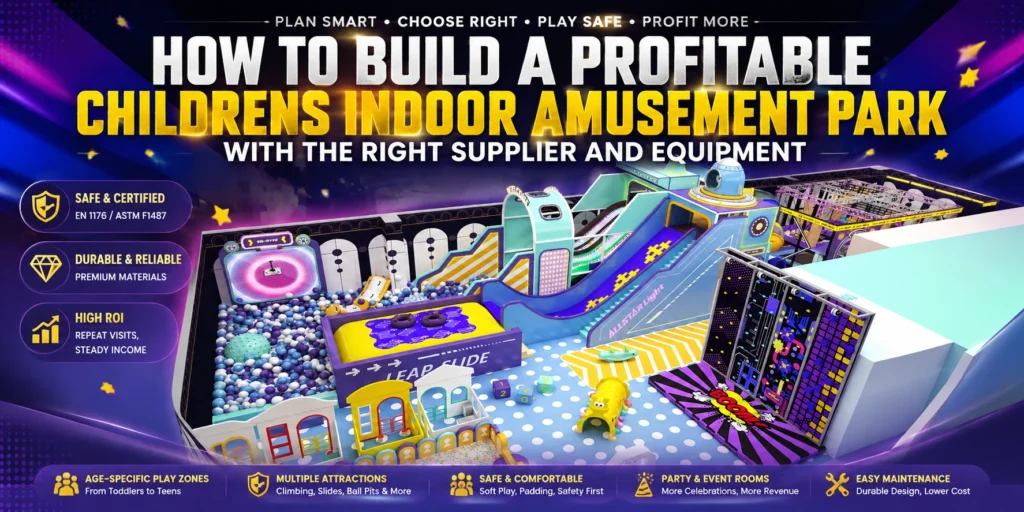
A childrens indoor amusement park is an indoor leisure venue where children play on age-specific equipment such as climbing frames, slides, ball pits, obstacle courses, and compact rides. Unlike outdoor parks, it operates in a climate-controlled space, so opening hours remain consistent whatever the weather. Typical facilities add party rooms and soft-play zones to drive repeat visits and steady ticket income.
Understand the concept, and the next step is seeing how a park operates day to day.
How Childrens Indoor Amusement Park Works
A childrens indoor amusement park runs on a scheduled cycle: entry, play, safety checks, cleaning, and reset. Verifying each stage helps you judge supplier suitability before purchase.
- Entry and access — tickets or wristbands control capacity; confirm the system handles peak queues.
- Structured play — children rotate through trampolines, ball pits, and climbing frames in timed sessions.
- Safety sweeps — staff enforce age and height rules, then inspect netting, padding, and fasteners.
- Cleaning and reset — surfaces are sanitised between sessions to protect repeat visitation.
Component Roles
Three component groups determine reliability: play frames, impact-absorbing surfacing, and safety barriers. Each must fit your floor plan, ceiling height, and daily footfall. Equipment from a commercial playground manufacturer China source can look identical in photos, so request cleaning-chemical compatibility data and daily maintenance schedules before you compare prices.
Your next check is comparing component types and product options side by side.
Childrens Indoor Amusement Park Components and Product Types
Component choice affects long-term running cost more than initial price, so measure each option against floor plan, target age group, and expected visitor turnover.
| Product type | Best fit for | Typical age range | Main buyer check |
|---|---|---|---|
| Soft play structures | Toddler zones and first-time visit safety | 0–4 | Foam density and cover seam quality |
| Multi-level climbing frames | Adding vertical challenge on a compact footprint | 4–12 | Platform clearance and fall height |
| Slides and ball pools | High-capacity play with quick session rotation | 2–10 | Ball volume per square metre and cleaning access |
| Interactive floor games | Repeat visits and group competition | 3–12 | Projector calibration and replacement cost |
Ask suppliers for the exact specification details before any price negotiation:
- Foam and cover grade. Request foam density (kg/m³) and PVC or PU cover thickness; higher figures raise cost but reduce refurbishment frequency.
- Fixing and anchoring method. Wall-anchored systems suit leased buildings; freestanding options allow re-layout but need heavier floor protection.
- Hybrid add-ons. Slides, tunnels, and crossing paths can extend the usable age range without enlarging the play area.
Typical Applications for Childrens Indoor Amusement Park
A childrens indoor amusement park is not one product; the venue decides the design, safety evidence and batch order you need. Match the structure to visitor flow, then request proof before you commit.
- Family entertainment centres and leisure venues. High footfall and mixed ages need multi-level frames. Request per-component load-test reports and EN 1176 or ASTM F1918 compliance sheets, not a blanket certificate.
- Shopping centres and retail landlords. Tenant fit-outs need compact footprints that meet mall fire and egress rules. Ask for fire-retardant ratings on foam, netting and upholstery, plus installation drawings with exit-path clearance.
- Restaurant, hotel and soft-play cafe sites. Smaller floors mean faster part wear, so confirm the supplier still holds moulds for that slide, panel or climbing piece; repeat batch orders depend on it.
Usage intensity sets buffer-stock quantity; venue rules set the inspection paperwork. With applications fixed, the next step is custom manufacturing and OEM cooperation.
Custom Childrens Indoor Amusement Park Manufacturing and OEM Cooperation
Custom manufacturing for a childrens indoor amusement park moves through five fixed stages. Send drawings, 3D files, or a reference sample first; the clearer your input, the tighter the quote.
| Stage | You provide | Manufacturer confirms |
|---|---|---|
| Quote | Drawings, sample, target quantity | Price, materials, lead time |
| Sample | Colour, logo, safety-standard approvals | Pre-production sample for sign-off |
| Packaging | Export packing and label preferences | Packing list and carton details |
| Batch inspection | Your checklist or third-party criteria | Inspection report before dispatch |
| Shipment | Delivery schedule and port | Loading photos and tracking |
Inspection timing
Book a playground equipment factory audit before batch release, or request video from the playground production line during runs. Both checks let you lock quality before money transfers.
With inspection completed and goods shipped, the remaining task is comparing suppliers for your next programme.
Top 10 Childrens Indoor Amusement Park Manufacturers and Supplier Fit
There is no universal ‘top ten’ for childrens indoor amusement park suppliers, so match manufacturer type to your buying role instead. Full-range factories suit complete park builds; custom OEM specialists support exclusive themed zones; trading companies help small importers test markets.
Tender buyers should verify documented playground quality control, while distributors need flexible batch sizes and fast RFQ replies. Compare four supplier categories below.
| Supplier type | Pros | Cons | Best fit |
|---|---|---|---|
| Full-range manufacturer | Single contract for trampolines, soft play, slides and ball pits; mature quality control | Higher minimum orders; slower bespoke work | Operators building an entire venue |
| Custom OEM/ODM specialist | Themed design support, CAD drawings and sample prototypes | Premium tooling costs; longer lead times | Brands needing exclusive layouts |
| Trading company or agent | Access to multiple factories; export logistics handled | No direct production control; verify inspection records | New importers trialling several markets |
| Regional fabricator | Faster local installation and after-sales response | Smaller capacity; limited documentation | Renovations and bolt-on expansions |
Score shortlisted candidates on certification, spares and inspection access:
- Playground factory certification plus third-party test reports (EN 1176 or ASTM F1487)
- Reference-site photos and client contact details
- Inspection points: raw materials, mid-production, pre-shipment
- Five-year spare-parts availability
- After-sales response time in your region
A cheap quote without certification is a liability risk, not a saving. Verify factory documentation before negotiating price.
About JQ Playground – wenzhouplaygroundmanufacturer.com
JQ Playground (Wenzhou Jiqi Amusement Equipment Co., Ltd.) is a children’s playground equipment manufacturer founded in 1993. The company provides design, customization, large-scale manufacturing, sales, installation guidance, and after-sales support for outdoor playgrounds, indoor playgrounds, soft play, water playgrounds, PE board playgrounds, kindergarten furniture, outdoor fitness equipment, pet playgrounds, and playground facilities. Approved company facts include 180+ employees, a large Wenzhou production base, 20+ production lines, 55 production machines, ISO/BSCI/EN1176/EN71/ASTM/CPC/CPSIC certification references, 100+ patents, free design support, OEM/ODM capability, trial installation before shipping, export experience, and one-year quality warranty.