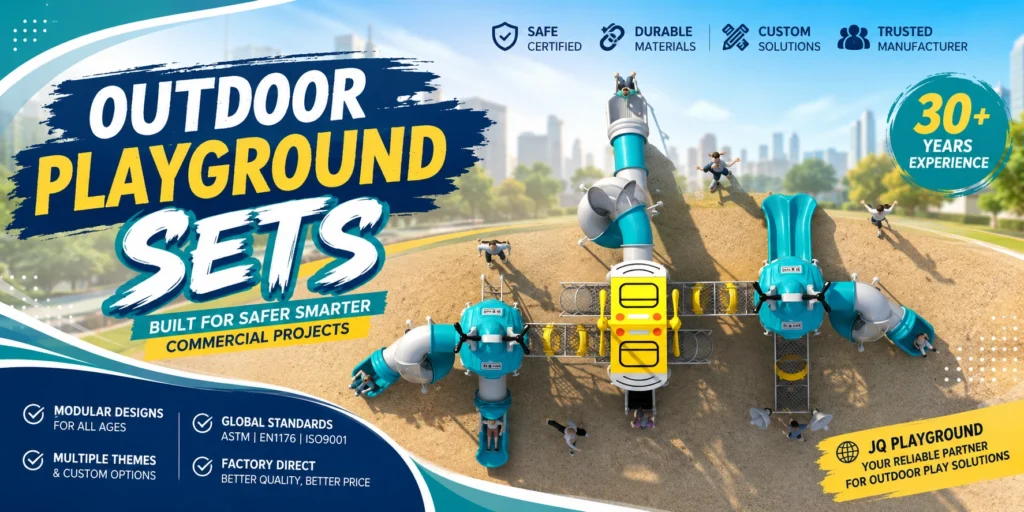
You’re sourcing a container of kids outdoor playground equipment from Wenzhou, but without proper verification, the shipment may include plastic parts that crack within a season, missing EN1176 certification papers, or assembly hardware that doesn’t match your site plan. Over 500 playground equipment factories cluster in the Wenzhou region, and quality varies drastically between suppliers.
Kids outdoor playground equipment refers to commercial-grade play structures designed for public or institutional use, including slides, swings, climbing frames, and modular systems, typically manufactured to safety standards such as ASTM or EN1176.
This article provides a structured guide to evaluating a Wenzhou playground manufacturer, understanding customisation options, and avoiding sourcing pitfalls.
Understanding the Types of Kids Outdoor Playground Equipment for Commercial Projects
Commercial playground equipment falls into three primary material categories: PE board (plastic), timber, and modular metal. Your choice affects durability, maintenance cycles, and installation complexity.
PE board (rotomoulded plastic)
– Constructed from LLDPE or HDPE, typically 5–8 mm wall thickness.
– Resists UV, moisture, and rust; colour fades after 5–7 years in direct sun.
– Common in schools, daycare centres, and indoor play areas.
– Lightweight panels reduce shipping volume — approximately 10–15 m³ per standard unit.
– Assembly requires bolting panels to support posts; skilled labour not essential.
Timber (pressure-treated wood)
– Usually pine or acacia with CCA-free treatment for rot and insect resistance.
– Offers natural aesthetic for theme parks, camping resorts, and heritage sites.
– Lifespan of 8–12 years with annual sealing; untreated wood fails within 3 years.
– Heavy and bulky — one timber fort can occupy 20 m³ of container space.
– Requires anchoring in concrete; assembly time can exceed 2 days.
Modular metal (galvanised steel with powder coating)
– Zinc-galvanised tubing (1.5–2.0 mm thickness) plus electrostatic powder coat.
– Highest load capacity and longest lifespan (15–20 years).
– Preferred for high-traffic public parks and large community projects.
– Compact knockdown design — a 10-station system fits in a 20ft container.
– Assembly demands torque wrenches and concrete footings; factory-trained crews recommended.
Wenzhou manufacturers typically produce all three types, so you can source multiple equipment lines from one factory. Equipment type directly influences shipping costs: PE board packs flat, metal is dense, timber is volumetric. Assembly requirements increase in the same order — plastic is simplest, metal intermediate, timber most labour-intensive. Factor 10–15% of total budget for installation labour when choosing timber or metal.
Key Quality and Safety Certifications to Verify with Your Playground Supplier
Certifications are non-negotiable proof that your equipment meets legal safety thresholds. Without them, you risk failed inspections, invalid insurance, and liability for injuries. For every target market, verify the correct standard: ASTM F1487 (USA), EN 1176 (Europe), AS 4685 (Australia), and the Chinese GB 19272 or GB/T 27689 for domestic projects. Each covers fall height limits, spacing between components, entrapment hazards, and structural integrity test methods.
| Standard | Target Market | Key Requirements |
|---|---|---|
| ASTM F1487 | United States & Canada | Fall height ≤ 3.05 m, 32–40 mm gauge spacing |
| EN 1176 | Europe (CE-marked) | Free height ≤ 3.0 m, head/neck entrapment checks |
| AS 4685 | Australia/New Zealand | Fall height ≤ 2.5–3.0 m, soft-fall zone calculations |
| GB 19272 | China (domestic) | Material toxicity limits, static load ≥ 1.5 kN |
Never accept a supplier’s word alone. Request a third-party test report from an accredited lab (e.g., TÜV, SGS, Intertek) and cross-check the certificate number online. For a playground factory Wenzhou supplier, insist on an on-site audit to inspect raw material certificates, the injection moulding process, and batch test records. An OEM playground manufacturer can provide these documents, but you must chase them. Skipping certification checks is the fastest route to a rejected shipment or a lawsuit.
How to Evaluate Customization Options and OEM Capabilities of Wenzhou Manufacturers
Once certification checks are done, shift focus to customisation depth. A structured evaluation prevents costly misunderstandings later.
1. Request a design brief. Specify colours, logo placement, theme integration, and preferred configuration (bolt-down for concrete pads or in-ground for natural surfaces). This forces the supplier to confirm feasibility from the first conversation.
2. Review tooling capabilities. LLDPE injection moulds differ from HDPE rotational moulds – the material grade directly affects impact resistance and UV stability. A custom playground manufacturer with in-house mould modification can adapt panel shapes without weeks of tooling delays.
3. Ask for material samples and CAD drawings. Request physical swatches of treated wood versus untreated pine, and PE board colour chips. Insist on a CAD drawing of your proposed layout and a sample mockup of any branded panel. Past OEM project photos reveal real capability more than sales brochures do.
4. Check lead times for custom orders. Colour swaps or logo prints typically take 15–20 days. A full theme redesign with new moulds can run 45–60 days.
Minimum order quantities vary by part complexity. Simple colour changes may require 50–100 units; custom themes often start at 300+ units. Expect a 10–15% cost uplift for bespoke designs versus catalogue models. Confirming these numbers early keeps your project budget and schedule realistic.
Avoidable Mistakes in Sourcing Outdoor Playgrounds from China and How to Prevent Them
Even experienced buyers trip over the same obstacles when procuring from Chinese manufacturers. Here are five common errors and how to sidestep each one.
-
Ignoring certification gaps. A supplier claims compliance with EN 1176 but provides only a Chinese GB test report. Your shipment lands, and the local inspector rejects it. Prevention: request third-party certification from an accredited lab that matches your target market — ASTM for the US, AS 4685 for Australia — before you place the order.
-
Skipping the factory audit. Photos and video calls can conceal poor welding, substandard rotomoulding, or unsafe gaps in climbing frames. At least one in-person or live-video factory audit should inspect raw material storage and the playground production line itself. Prevention: use a playground equipment factory audit checklist that covers weld quality, plastic thickness, and fall‑zone testing equipment.
-
Underestimating shipping volume and duties. A 40‑foot container holds roughly 25–30 cubic metres of play equipment, but bulky slides and modular frames waste space. Duties vary by HS code — often 6–8% for metal structures, higher for plastic. Prevention: ask your supplier for a container loading plan and exact HS code before you calculate landed cost.
-
Not specifying installation hardware. Many Chinese playgrounds arrive without anchor bolts, stainless‑steel fixings, or clear assembly instructions. You then scramble locally for M12 expansion bolts that may not match the predrilled holes. Prevention: insist on a packing list with piece counts for every nut, bolt, and washer, and confirm that the hardware meets your local corrosion standards.
-
Failing to verify after‑sales support. A loose bearing or cracked slide panel can take months to resolve if your supplier has no export warranty system. Prevention: agree in writing on defect‑replacement terms — typically 2% of order value held back until the issue is resolved — and confirm a communication point for spare parts.
Addressing these five points before you commit will save time, money, and the headache of a failed installation.
RFQ and Factory Audit Checklist for Verifying Wenzhou Playground Suppliers
Once you’ve avoided the common sourcing pitfalls, the next step is to verify your shortlisted suppliers systematically. Use this checklist to structure your RFQ and on-site audit. It covers four critical areas: documentation, production capability, physical quality checks, and shipping logistics.
Required Documentation
- Certificates – Request copies of ASTM F1487, EN 1176, or GB 19272 (depending on your target market). Cross-check the certificate holder name with the factory registration.
- Test reports – Ask for third-party lab reports for each model you intend to source. Look for fall height, entrapment, and impact testing results.
- Product liability insurance – Confirm the supplier carries coverage for public liability, typically with a minimum limit of $1 million USD per occurrence.
Core RFQ Questions
- Production capacity – How many units (e.g., standard 8-station modular playgrounds) can they produce per month?
- Export experience – Which countries have they shipped to in the past two years? Request shipping records or customs documentation.
- Minimum order quantity (MOQ) – Be specific: MOQ per model, per colour, or per container size.
- Payment terms – Typical terms are 30% deposit and 70% before shipment. Negotiate a 30/40/30 split if possible.
Physical Audit Points
- Raw materials – Inspect HDPE sheets for UV stabilisation additives. Check wood for treatment certificates (e.g., ACQ or heat-treated). Measure wall thickness of steel tubes (aim for 2.0 mm minimum).
- Completed units – Test swing hangers, slide joints, and clamp connections. Look for sharp edges, pinch points, and weld splatter.
- Welding and injection quality – Weld seams should be continuous, not tacked. Injection-moulded parts must have no flash or sink marks.
Logistics Checklist
- Container loading plan – Request a packing list showing piece count per carton, volume, and pallet dimensions. Verify that disassembled parts are nested to minimise empty space.
- Delivery terms – Clarify Incoterms (FOB Wenzhou or CIF destination port). Confirm the port of loading (commonly Ningbo or Shanghai).
Key RFQ Data Fields
| Specification | Quantity | Timeline |
|---|---|---|
| Model number, colour code, material grade | Total units + pieces per set | Production lead time + shipping duration (weeks) |
After reviewing documentation and audit findings, request a trial order of one to three sets. This allows you to verify assembly instructions, part numbering, and installation fit before committing to a full container. A trial batch also tests the supplier’s responsiveness to design or packaging feedback — a strong indicator of long-term reliability.
About JQ Playground – wenzhouplaygroundmanufacturer.com
JQ Playground (Wenzhou Jiqi Amusement Equipment Co., Ltd.) is a children’s playground equipment manufacturer founded in 1993. The company provides design, customization, large-scale manufacturing, sales, installation guidance, and after-sales support for outdoor playgrounds, indoor playgrounds, soft play, water playgrounds, PE board playgrounds, kindergarten furniture, outdoor fitness equipment, pet playgrounds, and playground facilities. Approved company facts include 180+ employees, a large Wenzhou production base, 20+ production lines, 55 production machines, ISO/BSCI/EN1176/EN71/ASTM/CPC/CPSIC certification references, 100+ patents, free design support, OEM/ODM capability, trial installation before shipping, export experience, and one-year quality warranty.