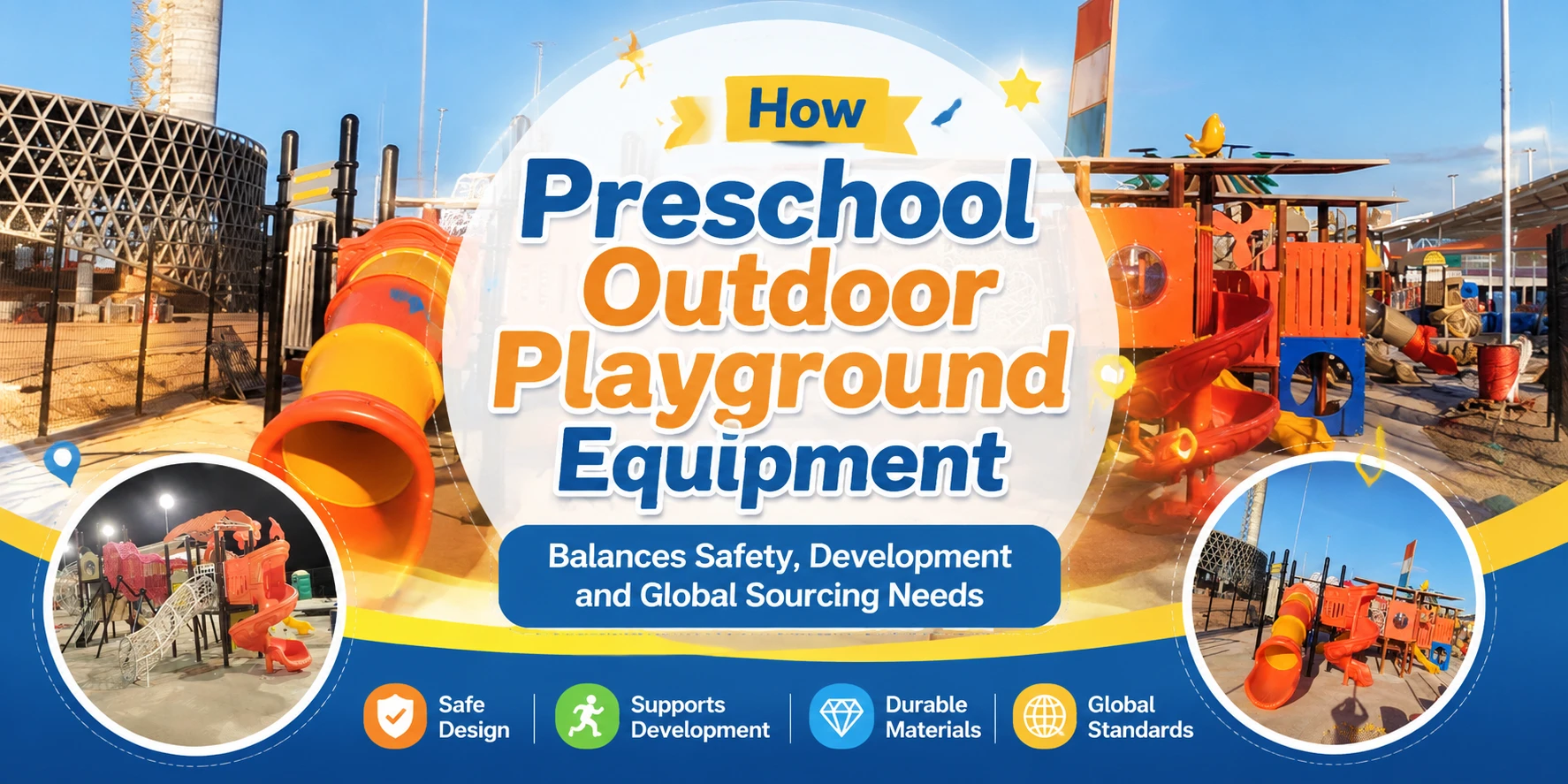
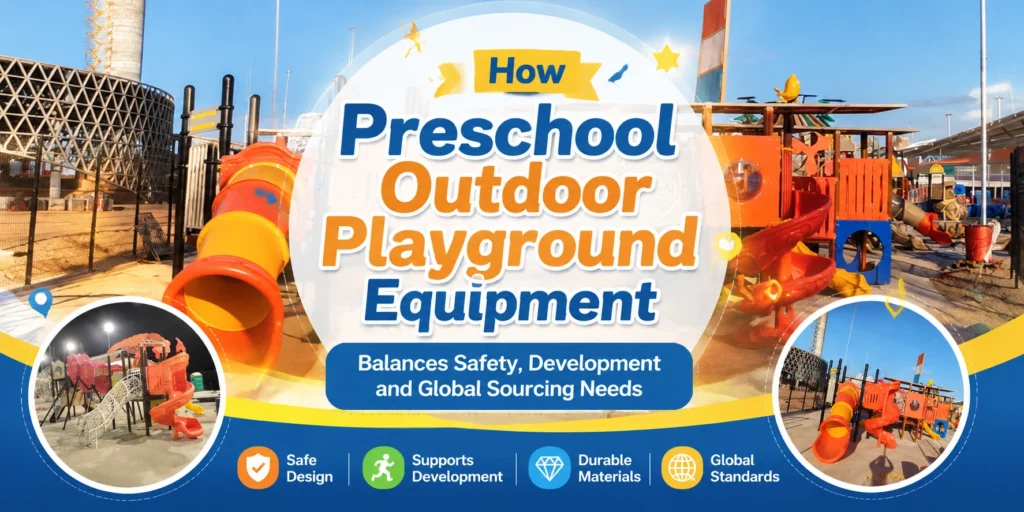
When sourcing playground equipment for a nursery or early years setting, you face two competing demands: the equipment must engage children aged 2–5, yet remain safe enough for their developing motor skills. Every slide height, platform gap, and material choice directly affects injury risk and long-term durability.
Preschool outdoor playground equipment refers to play structures designed for children aged 2–5, prioritising safety, durability, and developmental benefits. These units typically feature lower decks (under 1 m), rounded edges, and soft-fall surfacing to suit smaller users.
This guide covers common equipment types, relevant safety standards (ASTM F1487, EN1176), and the key factors to evaluate when selecting a Wenzhou playground manufacturer. Understanding these points helps you verify production quality, certification validity, and design flexibility before placing a bulk order with any playground manufacturer Wenzhou-based.
Essential Types of Preschool Outdoor Playground Equipment
Preschool playgrounds require equipment scaled for children aged 2–5. Each type has specific design considerations: low fall heights, soft edges, and small grip sizes. Here are the main categories you will specify when sourcing from a commercial playground manufacturer China:
- Slides – Typically 1.2–1.8 m high with a gentle slope. Wide steps and closed platforms prevent falls. Plastic is preferred in hot climates (metal gets too hot in direct sun). Choose rotationally moulded polyethylene for UV stability.
- Swings – Bucket-style seats with leg holes are standard for toddlers. Maximum swing height around 1 m. Frame materials: galvanised steel for coastal areas (corrosion resistance) or powder-coated aluminium. Rubber safety surfacing underneath is mandatory.
- Climbing structures – Low platforms (max 1.2 m fall height) with wide, rounded handholds. Nets and arch climbers encourage motor skills. Avoid gaps between 89–229 mm to prevent head entrapment per EN1176.
- Sandboxes – Depth of 200–300 mm with drainage holes. Lids are optional but recommended in rainy regions to keep sand dry and free of animal waste. Rot-proof timber (cedar or treated pine) or recycled plastic planks are common.
- Playhouses – Ground-level structures with small windows, doors, and sometimes a slide. Material choice: plastic shells for low maintenance; wood for natural aesthetics but requires annual sealing in humid climates.
- Seesaws – Low fulcrums with rubber bumpers to limit motion. Handrails and footrests are essential. Spring-based rockers are a safer alternative for 2–3 year olds.
Each category demands age-appropriate dimensions and materials that withstand local weather. A reputable kids playground manufacturer Wenzhou can adjust designs for your climate conditions, from tropical UV exposure to freeze-thaw cycles.
Safety Standards and Certifications for Preschool Playgrounds
Two primary standards govern preschool playground safety: ASTM F1487 in the US and EN1176 in the EU. Buyers who skip certificate verification risk liability claims, insurance voidance, and project rejections. Both standards address fall height limits, spacing between moving parts, and entrapment hazards, but their requirements differ in measurable ways.
| Aspect | ASTM F1487 (US) | EN1176 (EU) |
|---|---|---|
| Fall height limit | 1.8 m (6 ft) for preschool composite structures | 1.0–1.5 m depending on age group |
| Platform height max | No separate limit; governed by fall height | 0.6 m (under 3 yrs), 1.5 m (3–6 yrs) |
| Entrapment testing | Openings 89–230 mm must block head probe | Openings 89–230 mm must block head and torso probes |
| Critical fall surface | Required under any structure over 0.6 m high | Required under any structure over 0.6 m high |
Before ordering, verify these safety features on the certificate and product:
– No exposed bolt threads or sharp edges on any component
– Guardrails and barriers at least 640 mm high on platforms over 0.6 m
– Moving parts with pinch-gap clearances below 8 mm or above 25 mm
– Rung spacing on climbing structures between 200 mm and 300 mm centre-to-centre
– S-hooks on swings must be closed loop, not open
A qualified playground factory Wenzhou or OEM playground manufacturer will provide test reports from accredited labs for each standard you require. That same documentation proves due diligence to local regulators and insurers. Once you confirm the certification scope matches your target market, the next step is evaluating the manufacturer’s production controls and customisation capability.
Evaluating Manufacturer Capabilities: Quality Control and Customization
Certifications prove a factory meets minimum safety thresholds, but they don’t tell you whether the equipment will arrive consistent, on time, and built to your exact colour and design specifications. That’s why you must evaluate the manufacturer’s production controls and customisation flexibility before placing a volume order.
What to Check During a Factory Visit
Use this checklist to verify that the production line, materials, and testing infrastructure match the supplier’s claims:
- Raw material storage – Are plastic pellets stored in dry, dust-free silos? Check metal tube thickness against your specifications (e.g., 1.5 mm galvanised steel for structural supports).
- Injection mould quality – Inspect mould surface finish; rough moulds produce sharp edges on plastic parts. A good custom playground manufacturer will have a dedicated mould maintenance log.
- In-house testing lab – Confirm the lab can run impact, fall-height, and UV-stability tests. Ask to see recent test reports for identical product models.
- Colour consistency process – Request colour chips from the last three production batches to check for batch-to-batch variation. Pantone matching is standard for themed playgrounds.
- Production documentation – Look for shop-floor work instructions, inspection checkpoints, and a traceability system that ties each part number to a lot number.
A reputable ODM playground manufacturer will let you walk through these steps without hesitation. If the factory cannot show you a lab or a mould maintenance sheet, move on.
Customisation options typically cover theme-specific play panels (castle, jungle, space), colour combinations, and logo embossing on injection-moulded parts. The best suppliers offer 3D renderings before tooling begins, so you can approve the layout without costly rework.
Once you have confirmed the factory’s quality controls and design flexibility, the next decision point is packaging and shipping – how your equipment will be kitted, containerised, and documented for export.
Supply Chain and Export Logistics for Preschool Playground Equipment
Choosing between knock-down (flat-pack) and fully assembled playground equipment directly affects shipping costs, lead times, and on-site installation labour. Most preschool equipment is exported in knock-down form to maximise container utilisation. A typical preschool playground set in flat-pack occupies about 60 % of a 40‑ft container; fully assembled versions may require dedicated flat-rack containers that cost 30 % more to ship.
Container loading tips
– Calculate cubic volume per component and pack slides and beams into the container’s vertical space.
– Use a loading plan: group parts by assembly sequence to simplify your warehouse receiving.
– Request photos or video of the packed container as part of your quality check.
Lead times and MOQs
– Standard lead times run 25–45 days from order confirmation, with custom colours or logos adding 7–14 days. A factory audit of the playground production line will confirm capacity and scheduling.
– Minimum order quantities typically range from 5 to 20 sets, but many factories offer lower quantities for sample orders or repeat business.
Required documentation
– Commercial invoice, packing list, bill of lading, and safety certificates (EN1176 or ASTM F1487). The packing list must specify each component’s dimensions and gross weight to avoid customs delays.
– A playground equipment factory audit previously conducted on the supplier’s export documentation process can flag missing paperwork before shipment.
About JQ Playground – wenzhouplaygroundmanufacturer.com
JQ Playground (Wenzhou Jiqi Amusement Equipment Co., Ltd.) is a children’s playground equipment manufacturer founded in 1993. The company provides design, customization, large-scale manufacturing, sales, installation guidance, and after-sales support for outdoor playgrounds, indoor playgrounds, soft play, water playgrounds, PE board playgrounds, kindergarten furniture, outdoor fitness equipment, pet playgrounds, and playground facilities. Approved company facts include 180+ employees, a large Wenzhou production base, 20+ production lines, 55 production machines, ISO/BSCI/EN1176/EN71/ASTM/CPC/CPSIC certification references, 100+ patents, free design support, OEM/ODM capability, trial installation before shipping, export experience, and one-year quality warranty.